"Expanding the transactional-transformative paradigm"
Leadership Research by
Dr. David A. Jordan
President, Seven Hills Foundation
Chapter Two
Disagreement about the definition of leadership stems from the fact that it involves a complex interaction among the leader, the followers, and the situation. Some researchers define leadership in terms of personality traits, while others believe leadership is represented by a set of prescribed behaviors. In contrast, other researchers believe that the concept of leadership doesn't really exist.
Robert Kreitner and Angelo Kinicki (1998)
Review of the Literature
Introduction
The purpose of this literature review is to synthesize and analyze the published literature
concerning an emergent leadership construct variably termed transcendent, transcendental, or transcending leadership. Researchers investigating the phenomenon suggest that transcending leadership is an iterative extension to the extant transactional-transformational leadership paradigm. While there exists an abundance of published materials on transformational leadership - including more than 650 dissertations in various disciplines that have the term "transformational leadership" in the title (University Microfilm International, 2004) - therre is by comparison a meager sampling of published literature on the nascent transcending leadership phenomenon. This study seeks to discern the reasonableness of a transcending leadership construct by filling the gap in knowledge between those characteristics of transformational and trasactional leadership, which have been established in the literature and the unique aspects of transcending leadership, which remain undetermined.
Overview of the Review of the Literature
The review of the literature for this study incorporates two areas of focus. The first area
of focus involves a cursory review of extant literature by Burns (1978) and Bass and Avolio (1994) concerning the transactional-transformational leadership paradigm. The second area of focus considers propositions asserted to by Larkin, 1994; Aldon, 1998; Cardona, 2000; and Crossan, Nanjad, and Vera, 2002, who posit divergent bases for a transcending leadership phenomenon. A review of the bases upon which each of the four propositions is established is presented as contextual background in advance of a descriptive analysis of the respective studies.
In his seminal text, Leadership, Burns (1978) conceptualizes the constructs of
transactional and transformational leadership. This leadership paradigm has permeated leadership theory and research since its publication and is considered the fount from which new leadership (Bryman, 1993), theories, constructs, and approaches have emerged. Bass and Avolio (1994), in Improving Organizational Effectiveness through Transformational Leadership , broadens and enriches Burns' (1978) model with the introduction of their full range of leadership model. If it can be said that Burns is the conceptual architect of transactional-transformational leadership theory, then it must be stipulated that Bass and Avolio (1994) are the preeminent journeymen in operationalizing the paradigm. Drawing an inference from Burns' (1978) work, several researchers have recently begun exploring transcending leadership as a discrete construct, which could serve to extend the full range of leadership model. Though briefly mentioned by Burns, neither he, nor Bass and Avolio (1994) delve into the prospective phenomenon of transcending leadership to any meaningful extent.
A further area of focus in the review of the literature is to examine the parsimonious
research conducted on a transcending leadership construct. In her doctoral dissertation, Beyond Self to Compassionate Healther: Transcendent Leadership, Larkin (1994) suggests that transcendent leadership embodies a spiritual dimension, rooted in the dynamic of spiritual leadership. In a second study, Aldon (1998) ascribes a metaphysical perspective to the transcending leadership phenomenon in her thesis entitled, Transcendent Leadership and the Evolution of Consciousness. Aldon suggests that transcendent leadership is a consequence of the natural evolution of human consciousness. A third analysis by Cardona (2000), Transcendental Leadership, posits that the construct is fundamentally an enhanced exchange relationship between leaders and led where a willful desire to be of service to others is a defining characteristic. Finally, the work of Crossan, Nanjad, and Vera (2002), Leadership on the Edge: Old Wine in New Bottles?, suggests that the transcendent leadership phenomenon is a function of strategic leadership anchored in organizational learning.
Each of the nascent works on transcending leadership offers a disparate view on the
essence, or rich meaning, of a prospective leadership construct built upon the foundation of normative transactional-transformational leadership theory. While each suggests the presence of a transcending leadership phenomenon, none have conducted a comparative analysis of their respective assertions with the goal of conflating their disparate viewpoints. Rather, each study focuses on a particular point of view - or structural basis - and seeks to justify its perspective from that vantage point. By drawing inferences from each of the identified sources and comparing these inferences to characteristics evidenced in the lives of perceived transcendent leaders and normative transactional-transformational leadership theory, it is possible to gain insight into a body of knowledge relevant to this study.
The Evolution of Leadership Theory and Emergence of the Transactional-Transforming Paradigm
Beginning a meaningful inquiry into the reasonableness of a transcending leadership
construct demands an examination of the theoretical development of extant leadership theory with particular emphasis given to the transactional-transformational paradigm. Thoughtful academic research on the phenomena of leadership is generally agreed to have emerged toward the end of the 19th Century and early 20th Century (Chemers, 1997; Northouse, 2001; and Stogdill, 1974). Over the past 150 years, five families of leadership theory have emerged, as depicted in Table 1 (Summary Descriptions of Leadership Families). During the initial era of inquiry, Darwinist thinking prevailed, and leadership was thought to be based on heriditary properties (Bass, 1981). Such great man theory approached sequeiaed into an attempt to understand leadership by assessing leader traits. Trait theories, which surfaced in the early part of the 20th Century, prevailed for nearly five decades as preeminent leadership constructs, stipulating that leaders possessed certain characteristics, such as height, intelligence, and self-confidence, which set them apart from followers (Appendix A: Selected Leadership Trait Studies). By the 1950's, however, the field of psychology began to influence the frameworks in which researchers viewed leadership. Behaviorists suggested that leadership could more accurately be understood in behavioral terms, promoting the notion that establishing meaningful relationships with followers and creating task accomplishment structures were critical aspects from which to understand the nature of leadership (Appendix B: Selected Leadership Behavioral Studies). These behavior theories did not, however, adequately address situational variables and group processes (Yukl, 1994). A response to this shortcoming came in the advancement of situational-contingency theories in the 1960s, which proffered that leaders should adapt their approaches or actions pursuant to the context or situation. That is, accoridng to situational-contingency scholars, the situation dictates who emerges the leader or "the product of the situation" (Bass, 1990, p. 285). Situational-contingency theories, like trait and behavior theories, are primarily leader oriented where followers are considered the beneficiaries of leader influence.
Table 1
Summary Descriptions of Leadership Families.
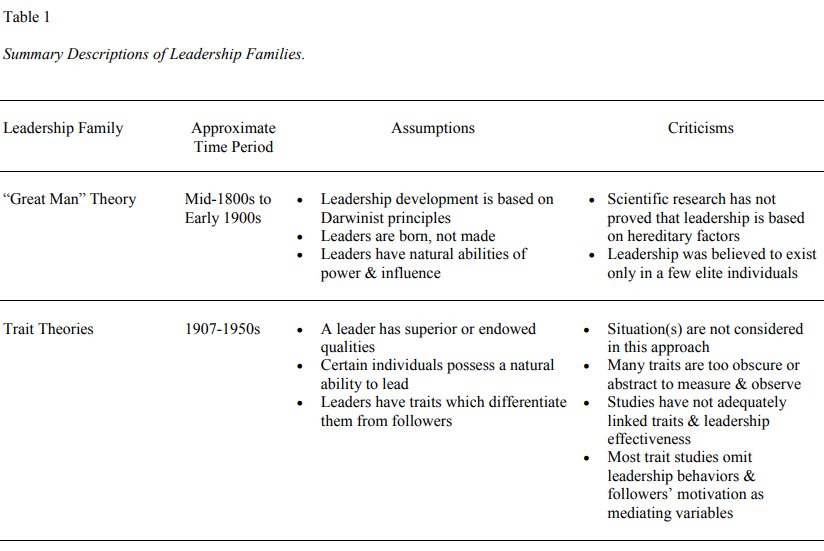

Source: Adapted from S. R. Komives, N. Lucas, & T. R. McMahon, Exploring Leadership for College Students Who Want to Make a Difference, (1998).
Dissatisfied with the situational-contingency theories' lack of attention to mutuality
between leaders and followers, researchers have begun to describe the nature of leader-follower relationships as reciprocal exchanges where activities result in a synchronicity of goal and need achievement. This thread of leadership research recognized that individual, group, and organizational performance is manifested in the mosaic of the social interplay between leaders and followers (Chemers, 1984). Recently introduced theories (House & Aditya, 1997) of leadership have attempted to integrate the interpersonal and intra personal dynamics found among individuals, groups, organizations, and societies. Appendix C (Leadership Theory Taxonomy) suggests a taxonomy of the leadership families and the respective theories, constructs, and approaches associated with each. It is instructive to note the iterative progression of leadership constructs over the chronological timeline and the migration of bases upon which the constructs have emerged. This suggests that leadership theory is in a perpetual process of refinement.
Among the integrative "new leadership" (Bryman, 1993) approaches to leadership theory,
one particular paradigm has received notable attention in the literature - the full range of leadership model. Inspired by Burns (1978) and operationalized by Bass and Avolio (1994), the full range of leadership model integrates the two constructs of transformational leadership and transactional leadership by delineating seven behavioral factors, and adding a laissez-faire (nontransactional) leadership dimension. As a means of accounting for the differences between revolutionary, rebel, reform, and ordinary leaders, Downton (1973) was first to suggest distinctions between the normative transactional leadership construct and a then new proffered transformational construct (Bass, 1990, p. 223). Later, Burns (1978) conceptualized a transactional-transforming leadership paradigm, which in turn was expanded upon and operationalized by Bass (1985) and Bass and Avolio (1994) as the full range of leadership model. The study of transformational leadership and its related transactional construct have since permeated the new leadership literature. In his seminal work on leadership, Burns (1978) presents his notion of transactional and transforming leadership within the context of political and social change milieus. He contends that,
The essence of leader-follower relation is in the interaction of persons with different levels of motivation and power potential in the pursuit of a common or at least joint purpose. That interaction, however, takes two fundamentally different forms [transactional and transforming] (p. 18)
As seen by Burns, transactional leadership is merely an economic exchange relationship (Blau, 1964; Homans, 1961); a formal transaction of goods for money, current influence for future favors, or other quid pro quo transactions. In the transactional construct, a leadership act takes place, but not one that ties leader and follower together in the mutual pursuit of a higher ideal. Burns (1978) further clarifies this definition by explaining that transforming leadership "occurs when one or more persons engage with others in such a way that leaders and followers raise one another to higher levels of motivation and morality" (p. 20). For leadership to be transforming, Burns designates three tasks. First, it positively affects the exchange relationship (mutuality) between leaders and followers. Second, an enhanced organizational culture is created by transforming leadership, inspiring followers to become more highly motivated. Third, transforming leadership stimulates positive social change both within the organization and external to it (Couto, 1993). Burns (1978) refers to this final task as moral leadership, stating " ... the kind of leadership that can produce social change that will satisfy followers' authentic needs" (p. 4). Not satisfied with having addressed the term once, Burns offers a further clarification when he suggests that moral leadership - also referred to as ethical leadership - "emerges from, and always returns to, the fundamental wants and needs, aspirations, and values of the followers" (p. 4). Figure 1 suggests a conceptualization of Burns transactional-transforming model as a hierarchical continuum.

Figure 1. Conceptualization of Burns' (1978) Transactional-Transforming Model of Leadership with behavioral descriptors. Arrows suggest a flow of leadership practice within a hierarchical continuum.
Burns (1978) drew upon Maslow's (1971) hierarchy of needs model, Kohlberg's
(1975) stages of moral development, Rokeach's (1973) structure of human values and Erickson's (1956) theory of psychosocial development as contextual factors to conceptualize his transactional-transforming leadership paradigm and the exigency of moral leadership. Burns felt that the congruence between human need, values, and moral development hierarchies contributed to the manifestation of "purposeful leadership" Burns, 1978, p. 44).
A congruence between the need and value hierarchies would produce a powerful potential for the exercise of purposeful leadership. When these hierarchies are combined with stage theories - for example, Erickson's eight psychosocial stages of man ... leadership, with its capacity to exploit tension and conflict finds an even more durable foundation (p. 44)
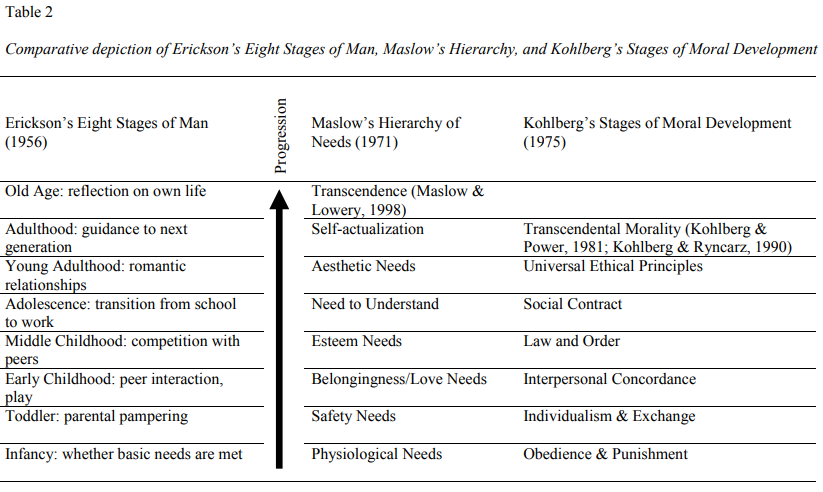
Burns posited that these hierarchies have a mutual influence on each other. That is, the conflicts a leader experiences during his or her stages of life (Erickson, 1956) can be resolved either positively (adaptive) or negatively (mal-adaptive) and that these "crisis points" impact the leader's moral development and values - either migrating the leader successfully upward through the hierarchical continuums or at a level of stasis. Bass and Avolio's (1994) full range of leadership model complies with Burns (1978) view that a principle function of leaders is in assisting followers to move upward through hierarchical levels of human needs, stages of moral development, and a structure of human values (p. 428). Table 2 provides a comparative depiction of the theories stipulated by Erickson (1956), Maslow (1971), and Kohlberg (1975). It is noteworthy that Maslow and Lowery (1998) added an additional "transcendence" level to Maslow's (1971) original hierarchy well after the publication of Burns (1985) seminal work. Maslow and Lowery (1998) suggested that while the self-actualization level involved finding self-fulfillment and the realization of one's own potential, the higher transcendence level concerns itself with helping others find self-fulfillment and the realization of their potential. Similarly, Kohlberg and Power (1981) and Kohlberg and Ryncarz (1990) broadened Kohlberg's (1975) six stages of moral development and positied the feasibility of a seventh stage - transcendental morality - which would affiliate non-dogmatic spiritual beliefs, or "transcendental properties", with moral reasoning (Sonnert & Commons, 1994).
Table 2
Comparative depiction of Erickson's Eight Stages of Man, Maslow's Hierarchy, and Kohlberg's Stages of Moral Development
Finally, Burns (1978) suggests a new, and perhaps, richer dimension to his transactional-
transforming leadership paradigm. He suggests the notion of a transcending leadership dynamic and posits the following description:
Transcending leadership is a dynamic leadership, in the sense that the leaders throw themselves into a relationship with followers who will feel elevated by it and often become more active themselves, thereby creating new cadres of leaders. Transcending leadership is leadership engagé. (p. 20)
While Burns suggests the idea of a transcending leadership, he does not fully incorporate it into his model of leadership theory. Instead, he offers it as an architect would a spandrel - an artifact that is left over in the execution of an original design - leaving the reader to interpret its significance. Figure 2 theories an expansion to Burns' transactional-transforming leadership model with the addition of a transcending leadership construct.

Figure 2. Conceptualization of a Burns (1978) inspired Transactional-Transforming Model of Leadership with the addition of a proffered transcending leadership construct. Arrows suggest a flow of leadership practice within a hierarchical continuum.
Subsequent to Burns (1978), a further elaboration on the transforming and transactional
leadership constructs was initiated by Bass (1985), culminating in the research by Bass and Avolio (1994). A fundamental departure between Burns (1978) and the early work of Bass (1985) concerned the relevance of a moral foundation as an integral aspect of transformational leadership. Bass posited that "transformational leaders vary from the highly idealistic to those without ideals" (Bass, 1985, p. 185) thus associating the malevolence of Hitler with the benevolence displayed by Gandhi. Bass discarded the attributes of moral good or evil and simply envisioned transformational leadership as producing change (Carey, 1992, p. 220). Bass & Avolio (1994) would later redress this discord and ascribe a moral imperative to transformational leadership. Bass & Steidlmeir (1999) would further pursue the relevance of a moral foundation and assert that authentic transformational leadership, as opposed to pseudo-transformational leadership, must incorporate a central core of moral values (p. 210).
[Authentic transformational leadership integrates] the moral character of the leaders and their concerns for self and others; the ethical values embedded in the leader's vision, articulation, and program, which followers can embrace or reject; and the morality of the processes of social ethical choices and actions in which the leaders and followers engage and collectively pursue. (p. 181)
The premise behind Bass and Avolio's (1994) full range of leadership model is that leaders demonstrate a range of transactional and transformational styles that may be categorized within a matrix of dimensions - effective vs. ineffective and passive vs. active. Within the model, leaders display gradations of competency in matching the frequency of each style they employ to the situational demands which concurrently understanding the psychological variables associated with the situation (i.e., how one motivates followers through positive exchange relationships, etc.) Bass and Avolio posit several factors, or behavioral descriptions of leadership action, within the full range model. The assert that laissez-faire leadership "is the avoidance or absence leadership, and is, by definition, the most inactive - as well as the most ineffective" (p. 4). Moving up the continuum are three additional transactional leadership styles: positive management by exception (MBE-P), active management by exception (MBE-A), and contingent reward (CR). The leadership style which Bass and Avolio proffer to be most active and effective - transformational - is positioned at the top of the model's continuum. Transformational leadership embodies four leadership behaviors (factors) - idealized influence, inspirational motivation, intellectual stimulation, and individualized consideration. Idealized influence - the first of four transformational leadership factors - involves leader behavior which engenders follower admiration, respect, and trust. Behavior associated with idealized influence includes: considering the needs of others in advance of personal needs; consistency in action; demonstrating high standards of performance and moral conduct; and avoiding the use of power for personal gain (Avolio & Bass, p. 2). Inspirational motivation is associated with follower motivation and inspiration stimulated by leader behavior. Enthusiasm, team spirit, open communication and shared vision are hallmark characteristic of inspirational motivation (p. 2). The third transformational leadership factor, intellectual stimulation, is indicative of leadership behavior which encourages follower creativity, innovation, and the challenging of the status quo. Individualized consideration is the final factor associated with transformational leadership and involves "special attention to each individual's [followers and colleagues] needs for achievement and growth by acting as a coach or mentor. Followers and colleagues are developed to successively higher levels of potential" (p. 3)
Bass and Avolio (1985) ascribe certain factors to the transactional construct. They
include: contingent reward, management by exception (active and passive), and the previously noted laissez-faire dimension. Contingent reward involves leader-follower agreement on assignments or tasks to be performed along with the compensation (reward) to be given assuming a satisfactory completion of the task. Management by exception involves a "corrective transaction" (Avolio & Bass, 2002, p. 4), which is evidenced either actively (i.e., the leader proactively monitors the performance of the follower(s) and takes immediate action to correct any deviances or errors from established standards) or passively (i.e., the leader waits for mistakes or deviances from established standards to occur; notes them; and then instigates corrective action.) Figure 3 depicts the full range of leadership model as presented by Bass and Avolio (1994).

Figure 3. Bass and Avolio's (1994) Full Range of Leadership Model with behavioral factors. Key: 4 I's (Idealized Influence, Inspirational Motivational, Intellectual Stimulation, Individualized Consideration); CR (Contingent Reward); MBE-A (Management by Exception - Active); MBE-P (Management by Exception - Passive); LF (laissez-faire) leadership.
Source: Adapted from B. M. Bass and B. J. Avolio, Improving Organizational Effectiveness through Transformational Leadership, 1994.
Bass (1985), perceiving transactional and transformational leadership as complementary
constructs, developed the Multifactor Leadership Questionnaire (MLQ) as a means of assessing transactional and transformational leadership behavior and the relationship between leader behavior and style with organizational effectiveness and follower satisfaction. Based upon the factors associated with the full range of leadership model (Figure 3), several iterations of the MLQ have been developed and made subject to extensive critical review (Antonakis, 2001; Lowe & Kroech, 1996) conforming its dominance as the preeminent model within "new leadership" (Bryman, 1993) theory. Avolio and Bass (1991) subsequently developed a Full Range of Leadership Development Program, which involves the MLQ assessment, feedback, and leadership coaching.
It is noteworthy that Burns (1978), with few exceptions, uses the term "transforming"
leadership while Bass (1985) and Bass and Avolio (1994) modified the descriptor to "transformational" leadership. Couto (1993) suggests that this distinction reflects a fundamental discord in the context from which Burns (1978) and Bass and Avolio (1994) approach their respective leadership constructs. Couto (1993) posits that Bass and Avolio's (1994) use of the adjective form of a noun, "transformation", modifies leadership and suggests a condition or state, whereas Burns' use of the term "transforming" implies the adjective form of a verb, which conceptualizes leadership as a process (In Wren, 1995, p. 104). This distinction has a bearing on the directionality of influence between leaders and followers. A transformational process infers that the leader is imbued with with the influential power to transform followers - a unidirectional dynamic. In constrast, the transforming process suggested by Burns (1978) asserts a bi-directional influence where leaders and followers may, through their mutual interactions, transform one another.
While Bass and Avolio (1994) provide to the dyadic transactional-transformational
structure the useful addition of a laissez-faire leadership dimension, along with other behavioral factors, they did not meaningfully address the nascent transcending leadership construct suggested by Burns (1978). Only recently has this phenomenon garnered attention from scholars. Burns' mention of a transcending leadership dimension that potentially broadens the extant transactional-transformational paradigm has stimulated an inchoate inquiry into the plausibility of a transcending leadership construct.
Thus far, a review of the literature has explored the prevailing transactional-
transformational leadership paradigm within the historic context of leadership theory. A cursory background on the paradigm is offered in order to establish a future juxtaposition with a nascent leadership construct - transcending leadership - which serves as the focus of this study. Table 3 (Comparison of characteristics associated with extant transactional-transforming leadership theory) provides a summation of the contextual background on the transactional-transformational leadership paradigm. What follows thereafter is an examination of the propositions put forth in the literature concerning a transcending leadership construct, along with a review of the contextual bases of each.
Table 3
Comparison of characteristics associated with extant transactional-transforming leadership theory as stipulated by Burns (1978) and Bass and Avolio (1994).


Transcending Leadership as a Spiritually Oriented Construct?
Background
Researchers and scholars have recently begun investigating the prospective relationship
between the dynamics of leadership and a leader's spiritual identity. Marinoble (1990), attempting to develop a clearer understanding of the ways in which the development of personal faith interacts with the process of transformational leadership, determined that spiritual faith had a diversity of meanings among the 12 study participant leaders interviewed in her study, and that "[spiritual] faith was viewed as a foundation to their leadership by some, but not all, participants" (p. i). In a Delphi study involving 22 national leaders, Jacobsen (1994) concluded "a strong inference that spirituality and transformational leadership are related" (p. 30). Jacobsen further concluded that leaders and followers seek more than extrinsic (economic) rewards in the workplace. Instead, they are redefining the nature of work to include aspects of spiritual identity and spiritual satisfaction. Fifty-nine percent (59%) of Jacobsen's study participants felt a greater integration of spirituality in the workplace was needed (p. 83). Beazley, H. (1997) extended the study of spirituality in organizational settings by proposing to construct a definition of spirituality an an associated leader spirituality assessment scale. Using a sample of 332 participants to define both the "definitive and correlated dimensions of spirituality" (p. 104), the study determined three correlated dimensions - service to others, humility, and honesty - and one definitive definition of spirituality - "living in a faith relationship with the Transcendent that includes prayer or meditation" (p. 173). A follow-up study by Beazley, D. A. (2002) was conducted for the purpose of investigating the premise that servant leaders are tacitly spiritual and that their spirituality correlates with the performance of managers in carrying out their leadership activities (p. 7). This study confirmed the correlated dimensions of spirituality - humility, honesty, and service to others - among organizational managers perceived to be servant leaders. The definitive dimension of spirituality - living a faith relationship with the Transcendent that includes prayer or meditation - was not substantiated among the study group of 300 leaders and followers (p. 73).
The conclusions drawn in other research studies militate against the correlation between
the leadership dynamic and the spiritual dimension of leaders. Magnusen (2001), in a study involving 350 school personnel, suggests that there is little to no statistical correlation between the beliefs, action/styles, and characteristics of spiritual leaders and effective school leaders (p. 108). Rather, the research concluded there are several qualities that inversely described spiriutal and effective leader types in the study and "that spiritual leadership and effective school leadership stand in juxtaposition with one another" (p. 111). Similarly, Zwart (2000), determined that, when empircally tested, a link between spirituality and transformational leadership, using Bass and Avolio's (1989) Multifactor Leadership Questionnaire and Beazley's (1997) Spiritual Assesment Scale, was not evidenct among the 266 individuals in her study; contradicting earlier qualitative research. Strack (2001) reported only slightly more favorable results in associating spirituality and the leadership dynamic. In his study of 319 healthcare managers, Strack determined a "moderately positive correlation (r = .50) between the latent constructs of spirituality and leadership" (p. 98) Table 4 summarizes a selected number of research studies associating spirituality and leadership.
Table 4
Summary of Selected Research Studies Associating Spirituality and Leadership.


The collective results of the research studies thus far noted suggests a mutable
understanding in the relationship between the constructs of spirituality and leadership. Though the association remains unclear, a profusion of scholars have seized upon the early research of Marinoble (1990) and Jacobsen (1994) and have posited their own association between the leadership function and the phenomenon of personal spirituality. Among the bevy of scholars who have published works on spirituality and leadership - which in have turn led to the proffering of a spiritual leadership construct - Bolman and Deal (1995), Fairholm (1998), and Mitroff and Denton (1995) are representative of those who have contributed significantly to the discourse. Fairholm (1998) asserts that leadership theory and practice has evolved over the past 100 years through five levels of virtual reality ranged hierarchically on a continuum from managerial control to spiritual holism (p. xix). The five leadership environments include: leadership as management, leadership as excellent (good) management, values leadership, trust cultural leadership, and spiritual (whole-soul) leadership. Fairholm, drawing on the earlier research of Jacobsen (1994), identifies spiritual leadership as an emergent construct suggesting that followers are desirous of leadership behaviors that emanate from the leader's inner core spirit (p. xxii).
Integrating the many components of one's work and personal life into a comprehensive
system for managing the workplace defines the holistic or spiritual leadership approach. It sees the transformation of self, others, and the team as important, even critical. This new leadership reality is that of the servant leader. (Fairholm, 1998, p. 118)
Fairholm goes on to suggest that an individual's spirituality is inseparable from their
actions or disposition, thus drawing a direct link between a leader's sense of spirituality and the values and behaviors they exhibit in the workplace. These demonstrable values either enhance or detract from the creative milieu of the organization. "Spirituality is the source of our most powerful and personal values. When leader and led can share core spiritual values, such as faith, trust, honesty, justice, freedom, and caring in the workplace, a true metamorphosis occurs" (p. xxiii). In contrast to the scholarly context of Fairholm's work, Bolman and Deal (1995, 2001) address the relationship of spirituality and leadership in metaphorical terms.
Bolman and Deal (1995, 2001), using the literary devices of metaphor and parable, tell
the story of a dispirited leader searching for meaning in both his personal and business life. With the help of a mysterious protagonist, he migrates through a personal journey of self-discovery resulting in the eventual certitude that one's spirituality and leadership values are not bifurcated dimensions, rather, they are a single unified construct - spiritual leadership. Bolman and Deal, like Fairholm (1998), assert that the last decade of the twentieth century has been witness to a paradigm shift in the role of leaders and followers as each seeks to find a deeper and richer meaning in their personal and work lives. Bolman and Deal (2001) posit that workplaces "are devoid of meaning and purpose... with little regard for what human beings need in order to experience personal fulfillment" (p. 6). Fox (1994) echoes this sentiment and entreats the reader to associate one's spiritual life with one's livelihood.
Life and livelihood ought not to be separated but to flow from the same source, which is Spirit, for both life and livelihood are about Spirit. Spirit means life, and both life and livelihood are about living in depth, living with meaning, purpose, joy, and a sense of contribution to the greater community. A spirituality of work is about bringing life and livelihood back together again. (pp. 1-2).
Bolman and Deal (2001) suggest to the read that popular leadership practices and organizational thinking have neglected to suffuse the enduring spiritual elements of courage, personal faith, and hope throughout the organizational environment. In contrast, they suggest that recently introduced theories of leadership perpetuate the charismatic role of the heroic champion as leader, or that of the analytical skills of the technocrat, as preferred leadership characteristics. "Leaders who have lost touch with their own souls, who are confused and uncertain about their core values and beliefs invariably lose their way" (p. 11). According to Bolman and Deal, a disconnection between the functions of leadership and leader spirituality is a cause of organizational atrophy. This premise is shared by Mitroff and Denton (1995) in their seminal study of spirituality within corporate cultures.
In their work, A Spiritual Audit of Corporate America, Mitroff and Denton (1995) state:
The soul is precisely the deepest essence of what it means to be human. The soul is that which ties together and integrates the separate and various parts of a person; it is the base material, the underlying platform, that makes a person a human being. Unfortunately, rather than seeking ways to tie together and integrate the potential inherent in the soul with the realities of the workplace, most organizations go the opposite route. (p. 5)
This suggests that the recent corporate leadership debacles at Enron, WorldCom, Waste Management, Healthsouth, Anderson, and other business organizations are not merely aberrations but are reflective of the spiritual impoverishment of leadership which, in turn, gives rise to amoral, immoral, and unethical business conduct. Mitroff and Denton assert that it is precisely this lack of spiritual compass that is creating the current ethical pandemic in American business leadership. The necessary response to this leadership malaise, as posited by the authors, is an embracing of the spiritual dimension by leaders and their organizations. That is, recognize that by treating employees and organization as spiritual entities, leaders will not only fulfill deep-seated psychosocial needs of followers, but also enhance an organization's ability to achieve competitive advantage. Mitroff and Denton, based on the responses of 215 individuals made part of their research study, concluded that individuals who are employed by leaders and organizations they perceive to be spiritual are less fearful, less likely to compromise their values, can bring more of their creative intelligence to bear, and consider their organization as more successful (p. xiv). Drawing on the findings of their two-year study employing questionnaires and in-depth interview techniques, Mitroff and Denton present ten principle results of their research. Several of these principles are noteworthy in furthering this study's analysis of the relationship between spirituality and leadership. They include:
"Respondents were not in discord over their general definitions of spirituality." They
broadly defined spirituality as "the basic desire to find ultimate meaning and purpose in areas of life and to live an integrated life" (p. xv)
"The respondents overwhelmingly sought to integrate, rather than fragment, their
spiritual lives and their work lives' (p. xv)
"Finally, ambivalence and fear are two of the most important components of spirituality.
Contrary to conventional thinking, spirituality does not merely provide peace and settlement; it also profoundly unsettles" (p. xix).
This last point - the disquieting nature of spirituality in leaders and followers - is one that
Wheatley (2002) supports in her assertions on chaos and leadership. She comments, "no leader can create sufficient stability and equilibrium for people to feel secure and safe. Instead, as leaders, we must help people move into a relationship with uncertainty and chaos. The times have led leaders to a spiritual threshold" (pp. 21-21). Attempting to provide a context in which to examine the role of the spiritual dimension, Richards (1995) states that there are four domains that make up our being: the physical, the mental, the emotional, and the spiritual. These four "energies" are interdependent, one upon the other, where the absence of imbalance of one creates disharmony in our lives. Morris (1999) suggests a similar construct of the human experience, which comprises four aspects termed the aesthetic, the intellectual, the moral, and the spiritual. Mitroff and Denton (1995) operationalize these constructs by emphasizing the important role that the spiriutal dimension has in the lives of individuals and organizations. They propose that leaders and their organizations would be well served by embracing a non-threatening, non-dogmatic, yet spiritually integrated business culture. In turn, according to the authors, followers will feel a greater sense of fulfillment and wholeness in their personal, work, and spiritual lives, which will lead to greater efficiency and productivity at work. Conlin (1999) concurs and has reported that when organizations actively support the use of spiritual activities for their employees, productivity improves and turnover is less pervasive. The result is a synergystic union between follower and leader, thus benefiting each. This premise of unifying the interests of leaders and followers is consistent with Burns' (1978) notion of transforming leadership and his emphasis on the moral dimension of leading. It may also evoke the higher virtues of leaders and followers reaching out to wider social causes, or collectivities, which Burns inferred to be aspects of a transcending leadership phenomenon.
Several authors have voiced a note of caution in defining the essence of spirituality and
its relationship to the phenomena of leadership. Chaleff (1998) attempts to segregate the phenomenon of spirituality from religious dogma. He contends that spirituality is the acknowledgement of a "sacred element within one's self and within each living being" (p. 9) and from this awareness there emerges a commonality in core values among leaders who share the proclivity. He asserts that when vision and passion - characteristics which Chaleff views as apposite to the leadership dynamic - are imbued with sacred values, then spiritual leadership becomes manifest. Hicks (2002) offers a comprehensive analysis of the existing literature on spirituality and leadership and concluded, "the concept of spirituality is more disparate and contested than the current leadership literature acknowledges (p. 379). Harvey (2001) contends that the disparate collection of works on leadership and spirituality lacks focus and a rigorous, defined methodology. Camp (2002) voices caution in stipulating an a priori relationship between spirituality and leadership stating, "the convergence of leadership and spirituality promises enormous potential for good. Likewise, such a convergence has the same negative potential for evil. Spirituality, absent its moral moorings in the common good may lead to self-obsession or self-distortion" (p. 37). Similarly, Bailey (2001) cautions that associating spirituality with any leadership construct remains ephemeral and requires the benefit of additional structural examination (p. 368). This amalgam of opinion has resulted in the prestigious leadership journal, The Leadership Quarterly (2002), to call for professional papers intended to "examine the influence of spiritual leadership on organizational variables and refine the construct of spiritual leadership" (p. 843).
An association between spirituality and leadership has been the focus of great interest
among leadership scholars in recent years. Research studies (Beazley, 1997; Beazley, 2002; Isaacson, 2001; Jacobsen, 1994; Larkin, 1995; Magnusen, 2001; Marinoble, 1990; Strack, 2001; Trott, 1996; Zwart, 2000) have attempted to draw an a priori relationship between the two dimensions, resulting in mixed determinations. Concurrently, scholars have produced numerous texts extolling leaders to embrace the "whole person" of followers within the organizational environment resulting in the proffering of a spiritual leadership construct (Bhindi & Duignan, 1997; Bolman & Deal, 1995 and 2001; Blanchard, 1999; Block, 1996; Chaleff, 1998; Conger, 1994; Fairholm, 1998; Hagberg, 1994; Hawley, 1993; Herselbein, Goldsmith & Beckhard, 1996; Holmes-Ponder, Keyes, Hanley-Maxwell & Capper, 1999; Mitroff & Denton, 1995; Moxley, 2000; Ponder & Bell, 1999; Vaill, 1998). Though an abudance of literature exists on the nature of spiritually oriented leadership, there remains contention as to its meaning and definition.
Larkin's Proposition of a "Transcendent" Leadership Construct
Larkin (1994), one of the first to pursue an investigation of transcendent leadership in her
study, Beyond Self to Compassionate Healer: Transcendent Leadership, ascribes a spiritual dimension to the phenomenon. Expanding upon Marinoble's (1990) earlier research, Larkin (1994) sought to draw together "the strands of spiritual awareness with growth beyond self-centeredness" (p. 2) and extrapolates specific characteristics regarding the integration of the leadership practices and spiritual beliefs among transformational leaders. Larkin stipulates from the outset that her research is predicated upon a predetermined definition of a transcendent leader as "transformational leaders with the added dimension of being known for their effective leadership, their comfort with self and others, and their commitment to a spiritual awareness of God" (p. 65). Given this overt bias as the basis of her search - and the criteria used in the selection of her 14 study participants - Larkin sought to identify "key characteristics of individuals who act as spiritually oriented transformational (transcendent) leaders" (p. 73). Larkin's phenomenological research resulted in the identification of five invariant themes among the study participants. They included: God-centered confidence, empowerment, hospitality, compassion, and humility. Manifesting behaviors associated with the five invariant themes included: tolerance toward others, servant leadership behavior, acceptance, energy, celebration, honesty, spiritual awareness, wholeness empathy, I-thou functioning, openness to see beyond self, and surrender (pp. 119-121). Given Larkin's stipulated definition of a transcendent leader as one who is a transformational leader, with the added dimension of maintaining a commitment to a spiritual awareness of God, the findings of her study would be expected. That is, spiritually oriented leaders tend to exhibit spiritually oriented behaviors and characteristics. With this apparent bias in the study methodology, Larkin's (1994) claim that the emergent transcendent leadership construct is primarily a spiritual phenomenon would appear to be an intriguing, yet suspect assertion. Nevertheless, Larkin is certain in her assertion that spirituality is the basis of the transcendent leadership phenomenon. Supporting this notion, Sanders III, Hopkins, and Gregory (2003) posit that "transcendental" leadership is fundamentally rooted in the spiritual domain; consistent with Thompson's (2000) postulate that transcendent leadership cannot occur without spirituality.
In summary, building upon the previous works of scholars and researchers who have
associated spirituality and the leadership phenomenon, Larkin (1994) contends that transcendent leaders possess certain invariant characteristics and corresponding behaviors. These invariant characteristics include: a God-centered confidence, empowerment of others, hospitality, compassion and humility. Manifesting behaviors, which Larkin asserts are apposite to transcendent leaders include: tolerance toward others, servant leader behavior, acceptance, energy, celebration, honesty, spiritual awareness, wholeness, empathy, I-thou functioning, openness to see beyond self, and surrender. Larkin's assertion that transcendent leadership is a spiritually oriented construct may yet prove a viable claim. An examination by Aldon (1998) has sought an ontological understanding of the transcending leadership phenomenon where spirituality may reasonably be conflated with the dynamic of human consciousness.
Transcending Leadership as a Reflection of Human Conscious Evolution?
Background
Tangentially related to viewing the leadership dynamic from a spiritual orientation, the
works of several scholars who have opined on the evolution of human consciousness and societal development have been contextually linked by Aldon (1998) as a means of explaining the iterative nature of leadership theory and to suggest a basis for a transcendent leadership construct. Drawing prinicpally upon the works of Elgin (1993), Toffler & Toffler (1995), Wade (1996), and Wilber (1996), Aldon (1998) asserts that when leadership is examined from a metaphysical perspective the "essence" of the leadership phenomenon can be viewed as an evolving state of consciousness, or being. Conceptualizing the leadership phenomenon from a conscious evolution basis presents a unique contextual framework in which to examine past leadership constructs and project future paradigms - notably, the reasonableness of a transcending leadership construct. Prior to advancing Aldon's (1998) assertion that transcending leadership is fundamentally a reflection of human conscious evolution, it is instructive to consider the work of several authors who have contributed to this knowledge.
The word consciousness is used to embrace a panoply of meanings and associations -
mind, intelligence, reason, purpose, intention, awareness, the exercise of free will, and so on (Zohar, 1990, p. 220). Among the scholars who have contributed to this litany of meanings- and through their work, either knowingly or unwittingly, instigated an ontological dialogue of the leadership phenomenon - Chatterjee (1998), Donald (2001), Goswami (1993), Hubbard (1998), and Zohar (1990) are noteworthy. Chatterjee (1998) asserts that leadership is a pilgrimage of human consciousness and a search for the sacred in life (p. 199). Leadership is then an expression of harmony and synchronicity between a leader's virtuous beliefs and actions, which her terms integrity. Chatterjee posits that "the greatest challenge that faces leadership today is to be able to strike a balance between the sustenance of the entire context of an organization while nurturing individual identities" (p. 174). He suggests three laws of conscious leadership, which may positively respond to a leader's ability in achieving this balance. First, the law of complete concentration emphasizes the importance of cultivating mental focus and purity of though. The art of concentration is acquiring the capacity to withdraw one's consciousness from all things except the one, single goal toward which one is striving (p. 176). Chaterjee's second law of conscious leadership is the law of detached awareness, which asserts that by moving beyond thought to a state of unconditioned consciousness (p. 177) - through contemplation or meditation - a leader can enter a heightened state of awareness and attention and see the whole of a situation or experience more clearly. The law of detached awareness suggests that a leader enters a new plane of consciousness where silence brings clarity of purpose or action to the leader. "The greater the detachment of leaders from their thoughts, the greater is their access to pure awareness" (p. 178). The law of transcendence is Chatterjee's third law of conscious leadership. While Chatterjee's second law of detached awareness concerns "the world of the actual", his third law of transcendence postures the leader as a visionary who relates to "the world of the possible" (p. 178). Leadership is then operationalized as a conscious path designed to discover and propagate the innumerable talents, ambitions, and possibilities of followers. Chatterjee posits that leaders practice the law of transcendence by foregoing the impulse to hold on to possessions, addictions, and the desire for egocentric power (p. 180). He asserts that the essence of leadership is embodied in an amalgam of a leader's values and moral virtues, which inform the leaders response to situations and experiences - a phenomenon he refers to as actionable spirituality.
Associating spirituality with the nature of human consciousness is further explored in the
works of Goswami (1993), Hubbard (1998), and Zohar (1990). Zohar (1990), in her work on the phenomenon of human consciousness, asserts, "while consciousness is in many ways the most familiar and accessible thing that each of us possesses, it remains one of the least understood phenomena in this world" (p. 62). Unlike dualist philosophers who contend that the mind and body are separate and that there can never be any physical understanding of the "self" (consciousness), Zohar proffers a scientific explanation of human consciousness where mind and body conjoin - termed holism.
... if holism to have any real meaning, any teeth, it must be grounded in the actual physics of consciousness, in a physics that can underpin the unity of consciousness and relate it both to brain structure and to the common features of every day awareness. (p. 75)
Zohar suggests a quantum mechanical model of consciousness manifest in the union
between two interacting systems: the computer like system of neurons which interact in the cerebral cortex and primitive forebrain to various stimuli, with an ordering and merging of various brain states (awareness) suggestive of the Bose-Einstein condensate (Bose & Einstein, 1924; Griffin, Snoke & Stringari, 1995). In biochemical terms, the Bose-Einstein condensate occurs when electronically charged molecules begin to vibrate in unison until they enfold so as to appear as one. Zohar (1990) applied this same principle in explaining the alignment of various brain states, or moments of conceptual awareness, in shaping consciousness, which Zohar terms the ground state of consciousness. Figure 4 depicts Zohar's (1990) conceptualization of the process of human consciousness; based on the principles of quantum mechanics and involving a complex interaction between the brain's neuronal activity and receiving stimuli.
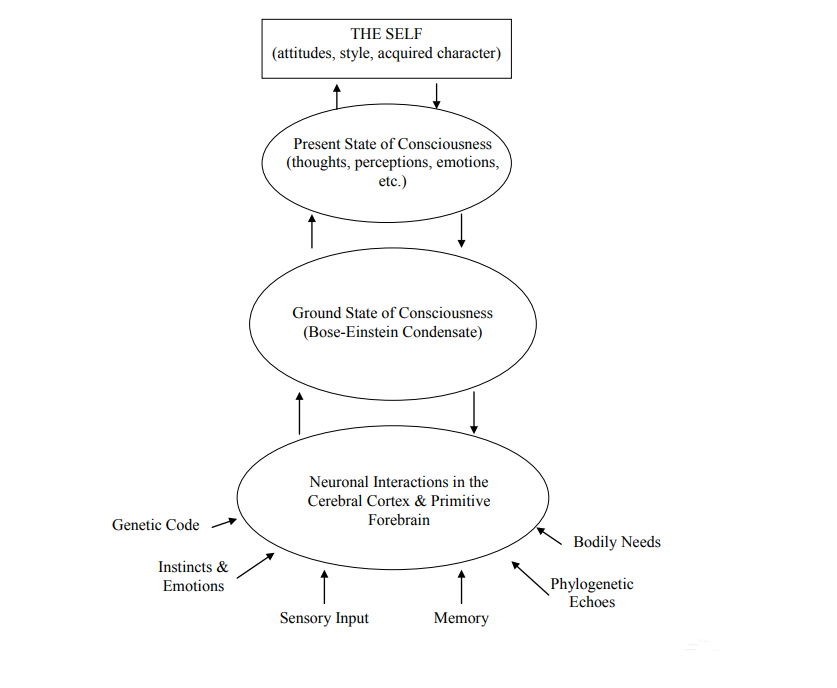
Figure 4. Zohar's (1990) Quantum mechanic model of consciousness (holism). Source: Adapted from D. Zohar, The Quantum Self: Human Nature and Consciousness Defined by the New Physics, 1990.
Zohar's quantum mechanical model of consciousness suggests that individual neurons
may cause unconscious responses, such as breathing or blinking, but collective and synchronistic neuronal actions produce an electromagnetic field, which instigates the state of human awareness. Zohar's assertion is supported by the research of McFadden (2002) in which he posits that outside stimuli, passing through our sense, is channeled through the brain's electromagnetic field to neurons and then back to the electromagnetic field creating a self-referring loop that is the key to consciousness.
Broadening her scientific explanation of human consciousness, as a reflection of coherent
(ground state) neuronal impulses responding to internal and external stimuli within the cerebral cortex, Zohar (1990) proffers a preternatural genesis of consciousness, which embodies a spiritual dimension. In this regard she expands her "holism" assertions on consciousness, which embodies a spiritual dimension. In this regard she expands her "holism" assertions on consciousness from the quantum mechanical realm of the individual to a quantum vacuum model of consciousness, which unites the consciousness of the individual to the consciousness of the universe, and by extension, to an immanent God. Figure 5 reflects Zohar's quantum vacuum model of consciousness.

Figure 5. Zohar's (1990) Quantum Vacuum Model of Consciousness. Matter and forces emerge as fluctuations (excitation) in the vacuum, grow toward renewed coherence (Bose-Einstein condensate), and return to the vacuum as "enriched" fluctuations. Source: Adapted from D. Zohar. The Quantum Self: Human Nature and Consciousness Defined by the New Physics, 1990.
Accordng to Zohar, a viable world consciousness must conflate personal, societal, and spiritual dimensions into a unified whole. In doing so, the individual has access to an understanding of the nature of his existence, the relevance of man's relationship to Nature and others, and his relative place in the cosmos. Zohar asserts that human consciousness, as a physiological process within the brain, has evolved over epochs of time and awakened the human species to a nascent understanding that we are all inextricably linked to an immanent spiritual source - thereby unifying the science of human consciousness with its spiritual front. Congruent with Zohar's concept of "holism" - as an expression of a conjoined human consciousness/spirituality phenomenon - Gowami (1993) introduced the philosophy of monistic realism, which proffers a relationship between mind (consciousness), body (matter), and science (quantum physics).
In an effort to identify a bridge which could unify a spiritual source of human
consciousness with Cartesian dualism - where the world is compartmentalized into the "objective sphere of matter (the domain of science) and a subjective sphere of mind (the domain of religion)" (Goswami, 1993, p. 15) - Goswami (1993) proffered the concept of monistic realism. As noted by Goswami, the dualist philosophy originally espoused in the early works of the 17th Century French scientist and philosopher, René Descartes, summarily divided human existence of God and His suffused presence in the lives of men and Nature. As a reflection of the prevailing acceptance of Cartesian dualism, however, phenomena of matter has been broadly relegated to the world of science (i.e., scientific materialism) in association with five principles of classical physics: strong objectivity - "the notion that objects are independent and separate from the mind (or consciousness)" (Goswami, 1993, p. 15); casual determinism - "the idea that all motion can be predicted exactly, given the laws of motion and the initial condition on the objects" (p. 16); locality - that all objects travel through space with a finite velocity; material monism - a philosophic belief, rooted in scientific practice, that "all things in the world, including mind and consciousness, are made of matter" (p. 17); and epiphenomenalism - "the idea that mental phenomena and consciousness itself are secondary phenomena of matter and are reducible to material interactions" (p. 278). Goswami (1993) inverted the assertion of epiphenomenalism by suggesting that consciousness - the phenomena of mind - serves as the primary reality; a philosophy he terms monistic realism.
The antithesis of material realism is monistic realism. In this philosophy, consciousness,
not matter, is fundamental. Both the world of matter and the world of mental phenomena, such as thought, are determined by consciousness. Monistic realism posits a transcendent, archetypal realm of ideas as the source of material and mental phenomena. Thus, consciousness is the only ultimate reality (p. 48)
Goswami's use of the term "transcendent" in his defintion of monistic realism is
significant in that he ascribes the transcendent realm to an immanent God and later defines transcendental experience as a "direct experience of consciousness beyond ego" (p. 284). By asserting that consciousness (mind), and not matter, is the ultimate reality he posits a unifying world view which integrates the transcendent mind and spirit into quantum physics - an assertion synergistic with that of Zohar.
Suggestive of Zohar’s(1990) description of human consciousness as a physiological
(quantum mechanical model) dynamic, Donald (2001) contends that consciousness is a complex relationship between the neuronal activities of the brain and the stimuli it receives. He asserts that the human mind is a distributed cognitive network which is shaped by a symbolic web (culture) and it is through the collectivity of individual and societal experiences that consciousness has evolved over eons of time. Donald further asserts that man’s search for purpose, “is anchored in consciousness [but that] it can never be truly attributed to a single conscious mind, in isolation. It is the conscious mind in culture that contributes to the source of teleology in the affairs of the human world” (pp. 323-324). Donald builds upon Zohar’s (1990) quantum mechanical model of conscious development within individuals and extrapolates its physiological basis to societies, or cultures of individuals, over time. Donald (2001) asserts that a societal collective consciousness of Man is an evolving and ever expanding phenomenon incrementally building upon past cultural milieus, mores, values, and historical experiences. Donald intimates that the iterations of Man’s conscious development are miniscule when viewed in isolation, but when seen collectively the result is significant. He suggests an emerging nexus between Man’s cognitive development and conscious evolution that may propel the human species toward remarkable growth in intellectual capacity – resulting in significant advances in science and technology, literature and the arts, philosophy and existential thought, and human interactions. The latter of these – human interactions – harkens the conceptualization of new forms of leadership and followership theory. Whereas Donald expands upon Zohar’s (1990) quantum mechanical model of consciousness (holism) he carefully circumvents making any overt spiritual associations to conscious evolution. In contrast, Hubbard (1998) attempts to enrich Zohar’s (1990) quantum vacuum model in stipulating a cosmic consciousness manifest in a universal intelligence (i.e., God).
Hubbard (1998) offers a model of conscious evolution which progresses through five
great epochs leading to our current state of existence. The first epoch begins with the creation of the Universe, thought to be approximately 15 billion years ago. Hubbard, like Zohar (1990), ascribes the source of all existence to an immanent God, who set in motion the precise design that led to matter, life, self-reflective consciousness and mans awakening to the whole process of creation (Swimme & Berry, 1992). The formation of the solar system and Earth, approximately 4 ½ billion years ago, defines the second epoch. Hubbard (1998) suggests that in the third epoch, 3 ½ billion years ago, sentient consciousness emerged in single-cell objects of Nature as life sought to reproduce itself through cellular division. The fourth epoch, some hundreds of millions of years ago, is noted for a quantum leap from single-cell organisms to multicellular life and a concurrent leap in what Hubbard terms, present oriented consciousness. Multicellular organisms began to sexually reproduce by the joining of their genetic material and evolving into plants and animals. Through the act of procreation, an “awareness” of life beyond the single organism became manifest. The fifth epoch is identified with the emergence of human life and the beginnings of self-consciousness. Hubbard suggests that throughout the whole of human existence man has sought to understand himself in relation to others, Nature and the cosmos, and to his perception of a spiritual source(s). As a result, consciousness continues on a progressive path toward an emergent epoch termed universal humanity, which effortlessly blends “our spiritual, social, and scientific capacities” (p. 52). Universal humanity in turn advances a cosmic consciousness – man’s awareness that a universal intelligence animates every atom, molecule, and cell and that God is this universal intelligence, or eternal Presence. The manifestation of this Presence is the human Spirit or Self (p. 30). Hubbard’s conceptualization of conscious evolution as a progression evolving away from its spiritual source, over the epochs of time, while simultaneously returning to its cosmic origin is consistent with the writings of cultural philosophers Jean Gebser (1985) and Rudolph Steiner (1971) who proffered that the ultimate manifestation of consciousness is the preternatural unification of Man with his spiritual source. Similarly, Teilhard (1975) noted, “We have seen and admitted that evolution is an ascent towards consciousness. Therefore it should culminate forward in some sort of supreme consciousness” (p. 258). That is, much like a Möbius strip which loops back and around itself forming a single continuous edge, conscious evolution has now entered an epoch in which Man is paradoxically moving toward his archaic genesis. Figure 6 is a conceptualization of Hubbard’s (1998) model of conscious evolution.

Figure 6. Conceptualization of Hubbard's (1998) Model of Conscious Evolution. Arrow depicts progression of consciousness over five epochs of time suggesting future iterations of life and human awareness. Source: Adapted from B. M. Hubbard. Conscious Evolution, 1990.
Hubbard's (1998) conceptualization on the iterative nature of consciousness is aligned with the earlier work of Bucke (1969) who suggested that consciousness could be defined in three forms: simple consciousness, which is possessed by the upper half of the animal kingdom; self-consciousness, by virtue of which man becomes conscious of himself as a distinct entity apart from the rest of the universe; and cosmic consciousness which Bucke described as an intellectual illumination leading to moral exaltation and an awareness of immortality and eternal life.
While Hubbard (1998) examined conscious evolution in terms of an unfolding cosmos
and Zohar (1990) attempted to explain the physiological mechanisms of the brain inherent in conscious development, each suggested a preternatural genesis - or spiritual source. This spiritual wellspring, in turn, sparked the initial emergence of human consciousness and may yet be nurturing to new and richer dimensions of the phenomenon. Both authors intimate that as our collective human consciousness is deepened and enriched, so too will our tolerance and compassion for each other and Nature be enhanced. This growing awareness of our global relationship with each other and to Nature may then suggest new models of leading and following built upon collaboration and exchange relationships designed to satisfy mutual intrinsic, as well as extrinsic needs.
Aldon's Proposition of a "Transcendent" Leadership Construct
One such new model - transcendent leadership - has been proffered by Aldon (1998) in which she posits that the phenomenon is fundamentally rooted in the evolution of human consciousness. That is, as human beings continue to advance as a species we develop a deepened awareness of ourselves and our inextricable connection to others, Nature, and to a spiritual source. Aldon expands upon Burns (1978) definition of transforming leadership, where "people raise one another to higher levels of motivation and morality" (p. 20), and posits transcendent leadership as a construct which "raises on another to higher levels of motivation, morality, and consciousness [thereby] co-creating the future in the essence of "spiritual humanism" (Aldon, 1998, p. 4). Spiritual humanism, a core element of Aldon's (1998) definition of transcendent leadership, is drawn from the work of Wilber (1997) who ascribes it to a metaphyiscal description where the essence of an individual is set in a deep spiritual context and made manifest in a spirit of community where values of trust, respect, love, and integrity are paramount. Aldon (1998) asserts that conscious evolution - reflecting the development of humankind over epochs of time - influences human interactions broadly and the manner in which leaders and followers interact, specifically. She then suggests a self-referral loop in the phenomenon where newly formed human relationship dynamics and leadership models instigate further enhancements in human consciousness; "... this author [Aldon] will urge the development of a leadership model that includes transcendence as an essential basic element. It is envisioned that such a model that is grounded in spiritual humanism can bring people to higher levels of consciousness" (p. 5). In essence, the evolution in human consciousness propagates new leadership constructs, which in turn support even higher levels of conscious evolution ultimately leading to spiritual humanism and the implied values and leadership behaviors of trust, respect, love, and personal integrity. Aldon integrates the putative theories of human conscious evolution of Elgin (1997), Wade (1996), and Wilber (1997) along with Toffler and Toffler's (1995) model of societal development. Table 5 offers a comparative depiction of the individual and societal stages of consciousness, as posited by Wade (1996), Wilber (1997), and Elgin (1993), along with Toffler and Toffler's (1995) striations of societal development.
Table 5
Comparative depiction of individual and societal models of human conscious evolution.

Source: Adapted from L. J. Aldon, Transcendent Leadership and the Evolution of Consciousness, 1998.
With the spectrum of consciousness theory depicted in Table 5 as her basis, Aldon (1998)
then posits a conceptualization in the evolution of leadership theory. She proffers that,
[leadership] theories are evolving a step behind the evolution of the individuals who created them. The movement from "great man" to trait/situational transactional [leadership] to collaborative/transforming leadership seems to be an outgrowth and improvement of what leadership practice previously prevailed. (pp. 73-74)
Figure 7 depicts Aldon's conceptualization of a unified societal evolution/conscious evolution/leadership evolution model proffering an emergent transcendent leadership construct.

Figure 7. Aldon's (1998) conceptualization of the evolution of leadership theory as a reflection of the evolution of human consciousness over the epochs of societal development. Source: Adapted from L. J. Aldon, Transcendent Leadership and the Evolution of Consciousness, 1998.
In summary, the evolution of the human conscious has been proffered by Aldon (1998) as
the integral basis for an emergent leadership theory she terms transcendent leadership. Aldon asserts that human consciousness, in its fullest and broadest sense, has developed along an evolutionary process from much simpler, very much more elementary forms of consciousness (Zohar, 1990, p. 220), so too has leadership theory and practice mirrored the progression of humankind. Where Larkin (1994) stipulated a fundamentally spiritual connotation to the prospective phenomenon of transcendent leadership from the outset of her study, Aldon (1998) approaches the construct seeking an ontological understanding. She ultimately determines that not only is the phenomenon of transcendent leadership a legitimate construct, but further, it is a logical reflection of conscious evolution as evidenced by societal and human development. Aldon (1998) then enriches her conscious-based theory of transcendent leadership by inserting a "spiritual humanism" (Wilber, 1997) dimension. This union intimates several behavioral factors associated with transcendent leaders - an attitude of trust toward followers and collaborators; respect for others and Nature; expressed love for people and the natural world; personal integrity, or moral character; and a spirit of community, in recognizing the interconnection and interdependence of Man's collective thought - or noosphere - stretching back to the beginning of global life (Aldon, 1998, p. 3).
The bases suggested by Larkin (1994) and Aldon (1998) in defining a transcendent
leadership construct are polemic in that both ascribe - either overtly or tangentially - a "spiritual" aspect to the leadership dynamic; an arguably subjective assertion. A more conformist explanation of the transcending leadership phenomenon has been proffered by Cardona (2000) who suggests that the essence of the phenomenon is rooted in extant Leader-Member Exchange (LMX) theory and manifest in an enhanced exchange relationship between leaders and followers; reminscent of servant leadership theory. Such an approach avoids the esoteric debate in associating a spiritual essence with the transcending leadership phenomenon.
Transcending Leadership as an Enhanced Exchange Relationship Construct?
Background
Conceptualizing the phenomenon of transcending leadership as a construct with an
implicit spiritual basis (Larkin, 1994) has been broadened by Aldon (1998) who describes transcendent leadership in monistic terms - as a construct conjoining spiritual humanism (Wilber, 1997) and the epochal evolution of human consciousness (Elgin, 1993; Toffler & Toffler, 1995; Wade, 1997). A third perspective on the essence of transcending leadership has been suggested by Cardona (2000), who deviates from the heretofore spiritually aligned bases. Cardona (2000) seeks to explain transcendental leadership in terms aligned with extant Leader-Member Exchange (LMX) theory (Dansereau, Graen & Haga, 1975; Graen, 1976; Graen & Cashman, 1975; Graen, Novak & Sommerkamp, 1982; Graen & Scandura, 1987; Graen & Uhl-Bien, 1991; Graen & Wakabayashi, 1994) and Servant Leadership theory (Greenleaf, 1970). In associating leader-member exchange theory with servant leadership theory Cardona (2000) asserts that transcendental leadership is fundamentally an enhanced exchange relationship where "the transcendental leader adds to the transformational construct the spirit of service, and the development of this spirit in others (transcendent motivation)" (P. Cardona, personal communication, April 11, 2003). Prior to analyzing Cardona's (2000) proposition that transcendental leadership is fundamentally rooted in a dyadic partnership between leaders and followers - where a willful service to others is a defining characteristic - it is contextually useful to review the bases of leader-member exchange (LMX) theory and servant leadership theory.
In contrast to viewing the leadership dynamic from the leader's perspective (e.g., trait or
behavior theories) or the follower and the context (e.g., situational-contingency theories), leader-member exchange (LMX) theory focuses on the dyadic relationship between a leader and followers (Northouse, 2001, p. 111) and the effect that this partnering has upon work group or organizational achievement. In this regard, LMX theory is unique within leadership research in that it establishes the dynamic relationship between leader and subordinates as the critical element of the leadership process (i.e., relational leadership). Originally conceptualized as the vertical dyadic linkage (VDL) model of leadership (Dansereau, Graen, & Haga, 1975), and later as leader-member exchange theory (Graen, Novak, & Sommerkamp, 1982), LMX theory has progressed through four stages of development (Graen & Uhl-Bien, 1995). Figure 8 illustrates the evolution of the leader-member exchange theory as suggested by Graen and Uhl-Bien (1995).

Figure 8. Stages in development of Leader-Member Exchange (LMX) theory. Source: Adapted from G. B. Graen and M. Uhl-Bien, Relationship-based approach to leadership: Development of Leader-Member Exchange (LMX) Theory of Leadership, 1995.
Stage One involved the early research of Dansereau, Graen, and Haga (1975) on work socialization resulting in the determination that supervisors developed widely varying relationships with their respective subordinates. Some subordinates reported a "high-quality social exchange" relationship with their supervisor, which was defined as a high degree of mutual trust, respect, and obligation - these employees were termed the "in-group". In contrast, other subordinates reported a "low-quality social exchange" relationship with their managers, reflective of a low degree of mutual trust, respect, and obligation - these subordinates were termed the "out-group" (Graen & Scandura, 1987). Stage One of LMX theory - or the vertical dyadic linkage (VDL) stage - asserted that leaders could not interact with followers uniformly (Graen & Cashman, 1975) because leaders had limited resources and time. As such, the social exchanges between the leader-follower, a two-way relationship, was determined as the unique premise and unit of analysis.
In Stage Two the terminology migrated from vertical dyad linkage (Dansereau et al.,
1975) to Leader-Member Exchange (LMX). Graen, Novak, and Sommerkamp (1982) expanded upon the notion that leaders do not maintain uniform exchange relationships with followers and asserted that high-quality social exchange relationships have a direct positive bearing on dyad and organizational performance. The converse is then implied for low-quality social exchange relationships. Sparrowe and Linden (1997) posit a similar position, asserting that strong ties between a leader and follower foster a relationship that builds loyalty, trust, mutual respect, and emotional attachment within the dyad. Stage Two moves beyond an understanding that different relationships between a leader and followers exist (i.e., VDL) to a discussion on how the dyadic relationships are formed and, consequently, the effects of the relationships on organizational performance. The implication is that when leaders and followers establish high-quality exchange relationships, positive organizational outcomes are enhanced.
Graen and Uhl-Bien (1991) are credited with conceptualizing Stage Three of LMX
theory, or the Leadership Making model. The Leadership Making model de-emphasizes the Stage One and Stage Two "in-group" and "out-group" social exchange relationship between a leader and follower(s) and accentuates the value of creating high-quality social exchange relationships with every follower, thus moving beyond the supervisor/subordinate relationship to one of a partnership relationship among the dyadic constituents. Graen and Uhl-Bien (1991) proffer a life cycle context to their Leadership Making model which suggests that individual dyads have the possibility of progressing through three states of relationship; the stranger state - consistent with the transactional leadership construct where exchange is predicated upon a formal relationship and subordination to the leader; the acquaintance state - where the social exchange relationship has not yet been formed into a partnership, but is somewhat more elevated than the "stranger" state; and, finally, the maturity, or partnership state - signifying a relationship of mutual elevation in trust, respect, and obligation. The maturity, or partnership state, is consistent with the characteristics espoused in the transforming leadership construct (Burns, 1978) where members of the dyadic group move beyond individual self-interests toward collective mutual interests (Graen and Uhl-Bien, 1995). The Leadership Making model (Stage Three) of LMX theory recognizes that in creating partnership relationships among all dyadic members the overall effectiveness and performance outcomes of the organization are enhanced. It additionally acknowledges that, although preferable, not all leader-follower (dyad) relationships will rise to the maturity (partnership) state. The essential element of the Leadership Making model, however, is that the leader earnestly offers and encourages each follower to enter into a high-quality social exchange.
In Stages One through Three, LMX theory development was foucsed on individual dyads
and the dyadic relationships between a leader and followers. Graen and Scandura (1987) conceptually broadened the understanding of how individual dyads form and support social exchange relationships. They extrapolated this knowledge to systems of interdependent dyadic relationships both within and external to the organization, thus asserting a forth stage of LMX theory. Graen and Scandura thus expanded the relevance and potenital of creating viable partnership relationships at work-unit levels, divisional levels, organizational levels, and inter-orgnaizational levels.
In summary, Leader-Member Exchange (LMX) theory is not broadly concerned about the
aspects of individual leadership or followership, per se. It is fundamentally interested in analyzing the relationship aspects which emenate between a leader and followers; referred to as relationship leadership (Komives, Lucas, & MacMahon, 1998). Leader-Member-Exchange (LMX) theory has evolved from the Vertical Dyadic Linkage (VDL) model, where high quality social exchange relationships (in-group) and low quality social exchange relationships within and external to work unit, divisional, and organizational levels. Establishing mature (partnership) social exchange relationships - the desirable end state of leader-member exchange - fosters a desire to satisfy the mutual interests of the dyadic member ahead of specific dyad or individual self interests (Graen & Uhl-Bien, 1995). This inclination of "others before self" is consistent with tenets of servant leadership espoused by Greenleaf (1970).
Preceding the research of Dansereau, et al. (1975) on leader-follower exchange
relationship by five years and Burns' (1978) seminal work on transactional and transforming leadership by eight years, Robert Greenleaf (1970, 1991) published his landmark treatise - The Servant as Leader. Greenleaf (1970) sets forth his concept of the "servant-leader", and later, the notion of primus inter paras (Greenloaf, 1976), or first among equals, in conceptualizing his philosophy of leadership and the role of a leader. Servant leadership - as a theoretical construct - is generally considered one of the "recently introduced theories" or "new theories' of leadership (see Appendix C: Leadership Theory Taxonomy), however, its lineage can be traced to the Sixth Century B.C. works of Chinese philosopher, Lao-Tzu (1998). In his compilation of meditations and writings entitled, Tae Te Ching - or How Things Work - Lao-Tzu writes, "True leadership teaches selflessness. Enlightened leadership is service, not selfishness. The leader grows more and lasts longer by placing the well-being of all above the well-being of self alone. Paradox: by being selfless, the leader enhances self" (In Wren, 1995, p. 69). Similarly, Hegel (1830) asserted that by first serving as a follower, an individual finds the foundation from which to emerge as a leader. Hegel felt the essence of leadership resided in servanthood. Hesse (1956) embraced the contention of servanthood informing leadership in his metaphorical work Journey to the East, in which the central character - Leo - first appears as a dutiful and humble guide and servant to a group of travelers on a spiritual quest. Later, when Leo leaves the group, their quest is thrown into disarray and their journey abandoned; the pilgrims had become reliant upon Leo's stability and absent his presence they lose confidence and direction. Ultimately, Leo is revealed as the titular head of an Order the pilgrims had originally sought. Leo the servant is thus revealed as a venerable leader and guiding spirit. Hesse's (1956) work, in turn, served as the inspiration for Greenleaf's (1970, 1991) conceptualization of contemporary servant leadership theory.
Inspired by Hesse (1956) and his own biographical antecedents, Greenleaf (1970, 1991)
defined a servant leader in what at first might appear to be an oxymoron:
The servant leader is servant first... It begins with the natural feeling that one wants to serve, to serve first. Then conscious choice brings one to aspire to lead. He is sharply different from the person who is leader first, perhaps because of the need to assuage an unusual power drive or to acquire material possessions. The leader-first and the servant-first are two extreme types. Between them are shadings and blends that are part of the infinite variety of human nature. The difference manifests itself in the care taken by the servant-first to make sure that other people's highest priority needs are being served. The best test, and difficult to administer, is: do those served grow as persons; do they, while being served, become healthier, wiser, freer, more autonomous, more likely to become servants; and, what is the effect on the least privileged in society; will he benefit, or, at least, will he not be further deprived? (Greenleaf, 1991, p. 7)
Spears (1998) codified Greenleaf's many essays and works on servant leadership into a
set of ten characteristics. Five of these characteristics are concerned with skills - listening, stewardship, growth of people, and community building; and one is internally directed - self-awareness. In addition to Spears (1998), a plethora of other servant leadership has appeared in peer-reviewed publications in recent years (Autry, 2001; Buchen, 1998; Choi & Mai-Dalton, 1998; Daft & Leagal, 2000; Farling, Stone, & Winston, 1999; Pollard, 1997; Russell, 2000; Sendjara & Sarros, 2002; Wright, 2000). Table 6 summarizes several of the studies and behavioral factors each ascribes to servant leadership.
Table 6
Characteristics of servant leadership.

Source: S. Sendjaya, Development and validation of servant leadership behavior scale, 2003.
Greenleaf (1970, 1991) asserted that servant leadership idealizes a leader's action of
caring for others (i.e., followers) by satisfying their intrinsic as well as extrinsic needs ahead of their own. Burns (1978) would echo this theme by noting that the role of a legitimate leader "emerges from, and always returns to, the fundamental wants and needs, aspirations, and values of the followers" (p. 4). Sergiovanni (1992) would add that, "servant leadership is practiced by serving others, but its ultimate purpose is to place oneself, and others for whom one has responsibility, in the service of ideals" (p. 138). Determining that follower needs are met, that followers are growing as individuals and in turn effecting other social collectivities, and that followers are cared for through honest and ethical means, are the crucibles upon which servant-leadership is based. "Caring for persons, the more able and less able serving each other, is the rock upon which a good society is built" (Greenleaf, 1976, p. 1). Sheldrake (2001) notes that,
"It [servant leadership] is an approach that makes it quite clear that means it can never be subordinated to ends: as such, it [servant leadership] represents an approach that is quite different from that which has characterized most writings on leadership over the past two millennia" (p. 6)
Given this premise, servant leadership can be considered a philosophy that emphasizes both the process and purpose of leadership whose modal values are in establishing a mutuality of trust, respect, and obligation between a leader and follower(s). Greenleaf (1970, 1991) not only asserted the importance of process in leadership, but also stimulated an inchoate inquiry into the ontological purpose of leadership. That is, why do leaders engage in behaviors which seek to create a change or stimulate action on the part of others. For Greenleaf, the question of "process" appears to have been satisfied in advancing the notion of primus inter paras (i.e., first among equals). Greenleaf addresses the issue of purpose through his assertions on the "servant-as-leader"; that is, meeting the needs of followers and helping them to grow as individuals who in turn can effect other individuals or causes.
Greenleaf (1970) ascribed an emerging moral, or ethical dimension, to the phenomenon
of leadership whereby a leader's use of coercive power yields to an expression of creative support by leaders to their followers. Greenleaf's seminal asertions on moral leadership would later significantly influence much of the "new leadership theories" proffered since 1970 (See Appendix C - Leadership Theory Taxonomy). Greenleaf (1970) stated,
A new moral principle is emerging which holds that the only authority deserving one's allegiance is that which is freely and knowingly granted by the led to the leader in response to, and in proportion to, the clearly evident servant stature of the leader. [Those who follow] will freely respond only to individuals who are chosen as leaders because they are proven and trusted as servants [author emphasis]. (In Greenleaf, 1991, p. 4)
Burns (1978) would later elaborate on the theme of moral (ethical) leadership originally proffered by Greenleaf (1970), noting:
By this term [moral leadership] I mean, first that leaders and led have a relationship not only of power but of mutual needs, aspirations, and values [and] that leaders take responsibilities for their commitments. I mean that kind of leadership that can produce social change that will satisfy follower's authentic needs. (Burns, 1978, p. 4)
Associated with his intimations concerning the moral basis of servant leadership, Greenleaf examined the ethical characteristics of leaders (Greenleaf, 1959).
Exploring an area of Greenleaf's writings which has received a modicum of published
analysis - Greenleaf's code of ethics - Fraker (1995) drew upon an unpublished manuscript entitled, A View of Managerial Ethics (Greenleaf, 1959) and identified five traits which Greenleaf posited as necessary for an ethical leader. These characteristics include:
Strength: The ability to see enough choices of aims, to choose the right aim and to pursue that aim responsibly over a long period of time.
Openness to Knowledge: One should respect, seek, and take reference from the available formal knowledge, cultivate what one's own resources of intuitive knowledge; and contribute what one can to the general pool of management knowledge.
Foresight: Leaders must see future events that will involve him before other people see them. The requirement of leadership imposes some intellectual demands that are not measured by academic intelligence ratings. They are not mutually exclusive, but they are different. The leader needs two intellectual abilities that are usually not formally assessed in an academic way: he needs to have a sense for the unknowable and be able to foresee the unforeseeable.
Entheos: Enthusiasm is a fundamentally essential characteristic for an ethical leader. More specifically, the Latin term entheos, which is the essence or power of activating one who is inspired supports the ethical characteristics of strength in a leader.
Sense of Purpose; Ability to Laugh: Ethical leaders have to have both a sense of purpose or goal, as well as a sense of humor about themselves and others. A goal is the big dream, the visionary concept, the ultimate consummation, which one approaches, but never really achieves. It is so stated that it excites the imagination and challenges people to work for something they do not yet know how to do. One can cultivate purpose to the point of having a glimpse of the ultimate and still remain connected with all people... purpose and laughter are twins that must not separate. Each is empty without the other. (In Fraker, 1995, p. 44)
Though largely uncredited, Greenleaf (1970) appears to have instigated a heuristic dialogue on ethical (moral) leadership, which has been furthered by Anello and Hernandez (1996), Burns (1978), Gilligan (1982), Gini (1996), Graham (1995), Heifetz (1994), Maldonado and Lacey (2001), and others.
Burns (1978) suggests that moral leadership is grounded in the responsibility of the
leader to help followers assess their own values and needs in order to raise them to a higher level of functioning, which emphasizes values such as justice and equality (Ciulla, 1998 in Northouse, 2001, p. 256). For Heifetz (1994) moral - or ethical leadership - involves the use of leader authority to help followers deal with conflicting values in rapidly changing work and social environments (Northouse, 2001, p. 255). Servanthood-to-others defines the essence of Greenleaf's (1970) perspective on moral (ethical) leadership and its madnate of focusing first on the needs of others. The invariant themes which permeate each of these perspectives is that ethical (moral) leadership embodies an ethic of caring (Gilligan, 1982) for others; the centrality of the leader-follower relationship (Dansereau et al., 1975); and the desire to establish higher moral purposes within both the leader-follower dyad and broader social collectivities (Burns, 1978).
Since the introduction of the servant leadership construct by Greenleaf (1970), a plethora
of texts, articles, and papers have been added to the body of knowledge. Russell and Stone (2002) have noted that the servant leadership lexicon has successfully transferred itself into general leadership literature and is so pervasive as to have fundamentally affected leadership theory. It is not the purpose of this study to examine the breath of published literature on the topic of servant leadership - a litany of texts and dissertations exclusively devoted to the topic have yet to exhaust its implications and nuances. Suffice it to say, however, that the construct has enjoyed a broad following across diverse organizational milieus - including healthcare - and may prove to have an associative relationship to the phenomenon of transcending leadership.
Schwartz and Tumblin (2002) posit that servant leadership is essential to "physician
leadership" in ameliorating the disparities in the nations healthcare system. They assert that,
Healthcare organizations in the United States continue to be dominated by (1) leaders who practice an outmoded transactional style of leadership and (2) organizational hierarchies that are inherently stagnant. Non health care service industries have repeatedly demonstrated that for business to compete successfully in a market economy, effective leadership is essential. (p. 1419)
Writing in The Physician Executive Journal, Wilson (1998), notes that since the United States has evolved into a service economy - as opposed to its heretofore agrarian and industrial based economies - an environment ripe to foster servant leadership principles is at hand. This is particularly so within the healthcare industry as health leaders confront a plethora of challenges including: globalization and the transference of communicable diseases; the need to satisfy multiple stakeholders within the public health milieu; environmental deterioration and its impact on local, national, and international public health; and the growing shortage of qualified labor to fill roles as healthcare professionals in developed countries (p. 6). Wilson posits that "the servant leadership model can enable individuals, organizations, communities, regions, nations, and the world to be at peace with each other" (p. 11). Whether naïve or prescient in his assertion, Greenleaf (1991) pointed to the special "servant to community" role that the health care delivery system plays in Western society, yet noted the unrealized promises made by the healthcare community and the burgeoning costs associated with it.
Health and social services retain too much from the days when magic potions were administered to banish symptoms. As a consequence, the extensive knowledge we not have about to live in better total health is effectively denied to a large number of people, and for many the longer life expectancy made possible by curbing disease is too often an empty achievement. The skyrocketing cost of such healthcare as we have is proof of the inadequacy of our system of health-care delivery. (Greenleaf, 1976, p. 6)
Greenleaf (1991) later cautioned against the surfeit of hospital facilities in America suggesting that as institutions they were losing their moral grounding and jeopardizing their servants-to-community legitimacy.
There is now the beginning of questioning of the extensive building of hospitals. We need some hospitals for extreme cases. But much of the recent expansion has been for the convenience of doctors and families, not for the good of patients - or even for the good of families. Only community can give the healing love that is essential for health. Besides, the skyrocketing cost of such extensive hospital care is putting an intolerable burden on health-care systems. (p. 28)
Wilson's (1998) observation concerning the important of healthcare within the emerging service-economy and Greenleaf's (1991) attributions concerning the ubiquitous presence of hospitals and their potential effect on the financial integrity of the U.S. healthcare system appear to be substantiated.
In their February 2004 study published in Health Affairs, Levit, Cowan, Sensenig, and
Catlin (2004) reported that U.S. healthcare spending rose to $1.6 trillion in 2002, reflecting an increase of 8.5% in 2001 and 9.3% in 2002. This aggregate total spending in 2002 represents an increase in health spending as a percent of the total U.S. gross domestic product from 13.3% in 2000 to 14.1% in 2001 and 14.9% in 2002. Hospital spending accounted for 32% of aggregate increase in 2002 and approximately 31% of total health expenditures in 2002 (p. 147). Table 7 illustrates the division of hospital costs versus other health delivery expenditures is 2002.
Table 7
United States' health spending by major category, 2002.

Source: Center for Medicare and Medicaid Services, Office of the Actuary, National Health Statistics Groups. In Levit et al., Health Spending Rebound Continues, 2002, 2004.
Note: The "All Other" spending includes dental, other professionals, other personal health care services, home health and nursing home care; durable and non-durable medical products; administration and insurance net cost; government public health; medical research; and medical construction.
The figures shown in Table 7 support the concerns expressed by Wilson (1998) and Greenleaf (1991) and their subsequent appellations calling for new leadership paradigms within the healthcare industry which could mitigate the financial challenges posed by a burgeoning service economy. In addition to Wilson and Greenleaf, who have opined on the usefulness of servant-leadership within the health care industry, there are a myriad of additional writers and scholars who have offered demonstrable support for the construct of servant leadership.
Renesch (1994) compiled the essays of 22 leadership scholars who have affirmed the
relevance of the servant leadership construct within the evolving spectrum of leadership theory. Additional scholars who have published works subscribing to the tenets of servant leadership include Blanchard (1995), Block (1993), Covey (1994), DePree (1989), Kouzes and Posner (1995), Senge (1995), Sergiovanni (1992), Sims (1997), Tatum (1995), and Wheatley (1994) - to name but a few. Each, in their own form of expression, agrees upon the fundamental premise that servant leadership emphasizes the basis of enhancing one's service to others through a holistic approach to the workpalce and the broader community. Greenleaf (1970, 1991) emphasizes the importance of leaders and followers making a journey together and undertaking that journey with mutual respect (Sheldrake, 2000). Supplementing the work of scholars who have proffered their own assertions on the essence of servant leadership, a number of contemporary research studies have attempted to add to the body of knowledge.
Representative of the recent studies on servant leadership theory include works by Boyer,
1999; Kirkpatrick, 1998; Laub, 1999; Lubin, 2001; Russell, 2000; Taylor, 2002; and Van Kuik, 1998. Boyer (1999) examined the life experiences of 15 perceived male servant leaders in an attempt to understand the biographical antecedents leading to a desire, or inclination, in expressing servant-leader behavior. Boyer also sought to derive common behavioral themes evidenced in her research participants and concluded that servant leader behavior involved four invariant themes:
1. The servant leader is caring, respectful, and understanding of others.
2. The servant leader stimulates awareness and open dialog.
3. The servant leader is authentic, trusting, and directed.
4. The servant leader establishes personal relationships and community through an informal and open style, which engenders teamwork and collaboration.
Kirkpatrick (1998) sought to understand key factors concerning servant leadership behavior as they may effect follower relations in cross-cultural situations. Laub (1999), employing a three-round Delphi approach with 14 "experts" on servant leadership theory, identified six primary servant leadership characteristics and then developed an instrument (i.e. the Servant Organizational Leadership Assessment - SOLA) for assessing the level to which leaders and followers perceive that these characteristics are displayed in their organizations. Lubin (2001), utilizing a descriptive study involving 18 "visionary leaders" (Sashkin, 1988), correlated the relationship between extant visionary leader behaviors with those characteristics broadly associated with servant leader behavior (Greenleaf, 1977; Spears, 1998). Of the ten normative servant leader behaviors, Lubin (2001) found that the behaviors of 18 nominated visionary leaders were congruent with nine of ten putative servant leadership characteristics. Russel (2000), studied 167 subjects characterized as having certain behaviors associated with servant leadership. He attempted to respond to the research question, "What specific leadership attributes characterize genuine servant leadership?" ultimately identifying nine "functional" and eleven "accompanying" attributes. Contending that research studies heretofore conducted on the servant leadership construct were broadly qualitative and emotional, thus providing limited empirical (quantitative) analysis, Taylor (2002) attempted to compare the leadership practices of school principals who self-reported utilizing the tenants of servant leadership with those who did not. Using descriptive statistics and univariate analysis of variance (ANOVA) techniques, Taylor found a statistical relationship between those principals who self-reported they embraced servant leader behaviors and the perceptions of followers (teachers) as to their enhanced leadership effectiveness. Van Kuik (1998) conducted an inductive qualitative study involving in-depth interviews with four informants for the purpose of exploring the meaning each gave to "service" (i.e., servant leadership) within their work environments. The study ultimately revealed four servant leadership themes consistent with all four informants. First, service provided them with a marked degree of personal fulfillment; second, the results of the informants past experiences, personal histories, and beliefs informed their proclivity to act as servant leaders; third, though different in specifics, each informant expressed a passion about an ideal; and finally, their relationships with followers were characterized by a high-quality social exchange relationship - or mutuality - manifest in a shared search for meaning in their work and personal lives coupled with a demonstrable sense of humility. "I saw all my informants as using their positions within the organization in the service of the shared ideal and placing that ideal ahead of their own advancement" (p. 232)
A high-quality social exchange relationship (Dansereau, et al., 1975) coupled with a
leader's willful desire to attend to the needs and aspirations of followers head of their own interests (Greenleaf, 1970, 1991) is consistent with Cardona's (2000) depiction of a transcendental leader.
Cardona's Proposition of a "Transcendental" Leadership Construct
In his paper, Transcendental Leadership, Cardona (2000) associates extant leader-
member exchange (LMX) theory and servant leadership theory asserting that leaders and collaborators create three different relationships - or forms of partnership - within the dyad: transactional, transformational, and a new form of partnership that Cardona terms - transcendental. According to Cardona, "transcendental leadership adds to the transformational one, a service orientation" (p. 201). The premise upon which Cardona establishes his assertions of the phenomenon of transcendental leadership are synergistic with exchange theory. That is, Cardona sets aside the immediacy of the leaders' individual behaviors or personal characteristics, as well as the match between a given situation and leader's style (i.e., situational leadership) and proposes to examine "the influence that the leaders' values and actions have on the relationship between leader and collaborator" (p. 201). This perspective is consistent with leader-member exchange (LMX) theory (Dansereau, et al., 1975). Cardona (2000) then enriches his posited basis of transcendental leadership as a function of leader-member exchange theory with the added dimension of servant leadership (Greenleaf, 1970, 1991). He notes, "I think the transcendental leader is a servant-leader, plus also transformational and transactional" (P. Cardona, personal communication, March 5, 2003). In doing so, he asserts that transcendental leadership is, in effect, an enhanced exchange relationship construct.
In proposing a definition of transcendental leadership - and by comparison definitions of
both transactional and transformational leadership - Cardona (2000) draws a link between the type of partnership and exchange relationships which the leader instigates among followers, the motivators to which followers respond, and the follow behaviors elicited by the partnership relationships. Table 8 (Taxonomy of a relational leadership model) offers a taxonomy of transactional, transformational, and transcendental leader-follower partnerships as suggested by Cardona.
Table 8
Taxonomy of a relational leadership model as suggested by Cardona (2000).

Source: Adapted from P. Cardona, Transcendental Leadership, 2000.
In conceptualizing his model of partnership and exchange relationships, Cardona proffers
a new and broadened dimension to heretofore extant exchange theory. Homans (1961) and Blau (1964) have long asserted two types of exchange relationships: economic and social. Economic exchanges are predicated upon an "explicit" agreement between two parties which are elucidated through an employment contract, personnel policies, letter of agreement, or other such formal mechanisms which state the terms of a specific quid pro quo agreement over a precise time period. In contrast, social exchanges are "implicit" agreements, which confirm non-specific understandings between a leader and follower(s). "Because these mutual expectations are implicit, they change as the relationship matures and as the socially-shared beliefs, or social norms, defining the relationship evolve" (Cardona, Lawrence & Bentler, 1999, p. 7). An example of such a non-specific obligation may involve an understanding that if a follower needs flexible time off to arrange for family emergencies, the follower would be expected to either make up the time later or arrange for the missed tasks to be accomplished. Expanding the long accepted striations of exchange theory as presented by Blau (1964) and Homans (1961), Cardona (2000) stipulates extant "economic" exchange theory, but bifurcates "social" exchange theory into two branches he terms work exchange relationships and contribution exchange relationships. In a working paper entitled, The influence of Social and Work Exchange Relationships on Organization Citizenship Behavior, Cardona, Lawrence, and Bentler (1999) proposed, "a new exchange relationship that we call work exchange. We develop a theory for the situation antecedents of OCB [Organizational Citizenship Behavior] that includes economic, work, and social exchange relationships" (p. 3).
According to Cardona, et al. (1999),
In a work exchange relationship, the individual and the organization holds an implicit agreement defining reciprocal expectations of specific work-related behaviors. Similar to social exchange, the mutual expectations defining a work exchange evolve as the relationship matures and social norms change. Thus, work exchange differs from economi exchange because it is an implicit agreement that evolves over time. But it also differs from social exchange because the obligations are specific to work activities, rather than diffuse or ill-defined social interactions. (p. 8)
Work exchange, as noted by Cardona (2000), is "based on the personal interest in the work itself" (p. 202). Cardona then defines a contribution exchange relationship as one that "is based on the contribution that the work makes to others" (p. 202). That is, within a contribution exchange relationship, leaders and followers seek to satisfy each other's needs, the goals of the organization, other individuals within the organization, and broader social causes and collectivities. The proffering of these two non-economic exchange relationships is apposite to Cardona's argument on the viability of a transcendental leadership construct. Though seemingly credible, no further research confirming the validity of Cardona's et al. (1999) proposition of a "new change relationship", termed work exchange, has been identified in the literature. Similarly, contribution exchange lacks any robust examination. Cardona (2000) readily stipulates to the dearth of corroborating research concerning his assertions on work and contribution exchange noting: "theories based on social exchange do not clearly distinguish between the two types of non-economic exchanges [work exchange and contribution exchange]" (p. 203). Cardona drew upon the work of Spanish scholar Perez-Lopez (1991) in proposing the notion of contribution exchange and its corresponding form of follower motivation, which Perez-Lopez termed transcendent motivation.
The origins of transcendent motivation (which I call in this paper, "contribution" exchange precisely because some people are confused with the term "transcendent" and mix it with spiritual meaning) comes from my Spanish mentor, Perez-Lopez. He always talked about the three types of motivation: extrinsic, intrinsic, and transcendent. And then, he talked about the different types of leaders (transactional, transformational, and transcendental) depending upon the motivation they promoted. I took that idea and developed the definition of a transcendental leadership (P. Cardona, personal communication, March 5, 2003)
Following his argument to expand extant social and economic exchange relationship theory, Cardona (2000) then associates each exchange with a corresponding partnership; economic exchange with transactional leadership, work exchange with transformational leadership, and contribution exchange with the phenomenon of transcendental leadership.
As illustrated in Table 8 (Taxonomy of a relational leadership model), Cardona suggests
the motivational bases for three different exchange relationships. He asserts that transactional leaders only promote extrinsic motivation (economic exchange) in their followers, transformational leaders promote extrinsic and intrinsic (work exchange); and the transcendental leader promotes three motivations - extrinsic (economic exchange), intrinsic (work exchange), and transcendent motivation (contribution exchange). In turn, Cardona attributes certain "following" behaviors to each of the partnerships. Transactional leaders promote uniformity in followers toward meeting rules and work requirements. Uniformity fosters a lack of follower initiative toward expending greater effort than is required to meet their obligations and contributes to a minimum degree of follower loyalty. Transformational leaders promote alignment in both the leaders and the followers interests. Consequences include follower creativity in approaching job assignments, a "learning environment", commitment by followers to the goals of the leader and organization, and a willingness to be proactive in taking on new responsibilities and autonomy. Transformational leaders, according to Cardona, promote a moderate degree of follower loyalty. Finally, extra-role effort, work unit and organization commitment, availability for extra assignments and high follower loyalty to the leader are indicative of the transcendental partnership. Cardona refers to this type of following behavior as unity (p. 203). Cardona then asserts that transcendental leaders possess certain competencies, which allow them to create and sustain high-quality contribution based exchange relationships. These competencies include the ability to negotiate and manage transactions (i.e., transactional leadership skills); form and communicate an inspiring vision of the future (i.e., transformational leadership skills); and exhibit the "integrity and capacity to sacrifice themselves in the service of their collaborators, even at the expense of their own interests", (p. 205), (i.e., transcendental leadership skills). The reification of his assertions leads Cardona to suggest corollary definitions of transactional, transformational, and transcendental leadership.
Building upon his triarchic framework of exchange relationships (i.e., economic, work,
and contribution exchanges), Cardona expands upon the typology of the full-range of leadership model (Bass & Avolio, 1994) and suggests the following definitions for what he refers to as "three types of traditional leadership" (p. 203).
Transactional leadership: is the leadership defined by an economically-based exchange relationship. In this relationship the leader promotes uniformity by providing extrinsic (positive or negative) rewards to the collaborators.
Transformational leadership: is the leadership defined by a work-based exchange relationship. In this relationship the leader promotes alignment by providing fair extrinsic rewards and appealing to the intrinsic motivations of the collaborators.
Transcendental leadership: is the leadership defined by a contributed based exchange relationship. In this relationship the leader promotes unity by providing fair extrinsic rewards, appealing to the intrinsic motivation of the collaborators, and developing their transcendent motivation. (Cardona, 2000, p. 204)
To further clarify the definition he ascribes to transcendental leadership, Cardona (2000) offers an expansive description of a transcendental leader. He notes:
The transcendental leader, as well as being interested in the results and in aligning the motivations of his or her collaborators with those of the organization, also tries to develop the transcendent motivation of these people. The transcendental leader centers his or her managerial work on the needs of the collaborators, but not in a manipulative way... Instead, the transcendental leader is concerned with the people themselves, and tries to contribute to their personal development. Specifically, he or she tries to develop the collaborator's transcendent motivation: the motivation to do things for others, the motivation to contribute. (p. 205)
In positing his definition of transcendental leadership, Cardona conflates his proffered theory of contribution-based exchange with the phenomenon of collaborator motivation.
Cardona asserts that the manifestation of the transcendental partnership is evidenced in a
synergistic relationship between leader and collaborator where the collaborator's motivation - pursuant to leader behavior - determines the type of partnership.
Although the element which defines the type of leadership (i.e. transactional, transformational, transcendental) is the collaborator's motivation in the relationships, the behavior of the leader is a critical element... In this dynamic relationship, the work of the leader consists of influencing, through his or her values and behavior, the motivations of the collaborator in order that the latter will seek to form with the former the richest possible partnership, i.e., a contribution partnership. (p. 204)
The importance Cardona ascribes to motivation is consistent with Greenleaf's (1970, 1991) theory of servant leadership.
Cardona (2000), drawing upon his definition of transcendent motivation and
transcendental leadership asserts, "Transcendental leaders are not as concerned about the collaborator's buying in to their vision, as they are to reach out to their collaborator's needs and development. This is also the insight of Greenleaf's [servant] leadership" (p. 205). Cardona makes clear that transcendental leadership is an amalgam of transactional and transformational leadership, as well as, servant leadership, "... the transcendental leader is not just a server [servant leader]; he or she is a transactional leader, who is also charismatic [transformational] and a server" (p. 205). In suggesting that transcendental leadership is mutually inclusive of and an iterative extension to the normative transactional-transformational leadership paradigm, Cardona is philosophically consistent with the prior work of Burns (1978) and Bass and Avolio (1994) in viewing the leadership phenomenon as a bi-directional continuum.
In summary, Cardona (2000) draws upon, and then enriches, extant leader-member
exchange theory (Dansereau, et al., 1975) with servant leadership theory (Greenleaf, 1970, 1991) and then proffers a new form of leader-collaborator partnership termed, transcendental leadership. To support his proposition, Cardona (2000) proffers an expansion of normative economic and social exchange theory (Blau, 1964; Homans, 1961) by including two new forms of social exchange - work exchange and contribution exchange. In asserting these new forms of exchange relationship, Cardona (2000) then establishes a triarchic framework on which to build his relational leadership model. This model consists of transactional leadership, transformational leadership, and transcendental leadership - along with corresponding collaborator motivations (i.e., extrinsic, intrinsic, and transcendent); following behaviors (i.e., uniformity, alignment, and unity); competencies; and consequences. Cardona asserts that the relationship which is established between a leader and collaborator (i.e., partnership relationship) is defined by the motivation of the collaborator, reflecting the values and behaviors evidenced by the leader. Cardona then adds to this the motivation to do things for others, which is the essence ascribed to servant leadership.
Though compelling, much of Cardona's argument in establishing the reasonableness of a
transcendental leadership construct reifies his own assertions on a triarchic framework of exchange relationship - one which stipulates the extant economic exchange, but proffers two new forms of social exchange. The exiguous research confirming the viability of work and contribution exchange relationships - which is the crucible upon which Cardona's (2000) transcendental leadership construct is predicated - casts a degree of pallin stipulating his otherwise ingenuous assertion that a transcendental leadership construct is viable and manifest in a union of leader-member exchange (LMX) theory and the servant leadership theory.
A fourth proposition in conceptualizing the reasonableness of a transcending leadership
construct eschews any corollary to a spiritual dimension (Larkin, 1994), an affinity to the metaphysics of human consciousness (Aldon, 1998), nor espouses new grounded theory involving leader-member exchange relationships (Cardona, 2000). Crossan, Nanjad and Vera (2002) propose the reasonableness of a transcendent leadership construct predicated upon extant strategic leadership theory.
Transcending Leadership as a Function of Strategic Leadership?
Background
The construct of strategic leadership (Cannella & Monroe, 1997; Child, 1972; Finklestein
& Hambrick, 1996; Hambrick, 1989; Hambrick & Mason, 1984; Hosmer, 1982; House & Aditya, 1997; Ireland & Hitt, 1999; Pawar & Eastman, 1997; Rowe, 2001) was initially introduced into the literature as a juxtaposing response to the broad acceptance of situational-contingency theories of leadership being proffered during the late 1960s and early 1970s. Situational-contingency theorists (Fiedler, 1967; House, 1971; Osborn & Hunt, 1975; Vroom & Yetton, 1973) emphasized the centrality of the immediate work dynamic, or situation, in guiding leadership action - a reaction to environmental variables. Alternatively, a cadre of researchers refocused the attention given to situational dynamics and began to reflect upon the prominence of the leader in proactively establishing strategic intent and direction as a means to effecting organizational outcomes. In lieu of passively responding to situational dynamic, the leader was positioned as an advocate-strategist in shaping organization culture and guiding its trajectory in achieving desired outcomes. Among those who have contributed to the notion of "leader as strategist" (i.e., strategic leadership) Cannella & Monroe, 1997; Child, 1972; Finklestein & Hambrick, 1996; and Hambrick & Mason, 1984 are notable.
Child (1972) argued that the influence exerted by top leaders in determining and guiding
the strategic choices of an organization was a critical factor in determining organizational culture and outcomes. That is, rather than highlight the dominance of the situation as the principal determinant of organizational outcome, Child asserted that the ability of the leader to inuit the environmental dynamics and then craft the necessary strategy to obviate the situational obstacles was the critical factor. Hambrick and Mason (1984) advanced Child's (1972) assertion that the influence of the leader, or guiding coalition of top leadership, was instrumental in achieving organizational intent. They asserted the both organizational culture and ultimate performance were directly linked to the strategic decisions made by "upper echelons" of leadership. "Organizational outcomes - both strategies and effectiveness - are viewed as reflections of the values and cognitive bases of power actors in the organization" (Hambrick & Mason, 1984, p. 193). Cannella and Monroe (1997) added to the work of Hambrick and Mason (1984) on the primacy of upper echelon leaders in influencing organizational culture and the crafting of strategic intent. Cannella and Monroe (1997) employed the constructs of positive agency theory (Jensen & Mechling, 1976; Fama & Jensen, 1983) as a means of discerning a realistic view of leaders and the prominence they possess in shaping corporate strategy. They concluded that top leaders did have an associative impact upon strategy creation and organizational performance, but that additional research "was necessary to explain the complex behaviors of top managers" (p. 232) vis-à-vis the performance of the organizations they lead. Cannella and Monroe (1997) contend that variables, including a leader's psychological characteristics, formal education or work background, and authorized discretion to act, or latitude of action (p. 221), are determinants in understanding upper echelon leaders. Finkelstein and Hambrick (1996), stipulating the contentions made by Child (1972) and Hambrick and Mason (1984) that strategic leadership is primarily concerned with the role of executives and the influence of their choices on the organization, conducted a comprehensive analysis of the limited number of empirical studies associating organizational performance and the characteristics of upper echelon leaders. They concluded that leaders do have a critical role in determining organizational success though they are often hobbled by the dynamics of organizational inertia, internal or external situational factors, psychological factors inherent within the leader, or organizational limits on the amount of discretion afforded the leader. Establishing the critical role of upper echelon leader(s) in shaping organizational culture and crafting strategic intent has been a hallmark contribution of strategic leadership theorists. Beyond concurring to the preeminent role of the leader in strategy development and implementation, other scholars have attempted to discern the differences in leading versus managing strategic intent and direction (Hambrick, 1989; Hosmer, 1982; House & Aditya, 1997; Pawar & Eastman, 1997).
Hosmer (1982), as a precursor to later research in differentiating leadership and
management, asserted that strategic leadership is a less delimited form of strategic management. "It is strange that strategic management, which purports to center on the duties and responsibilities of the general manager, has never defined leadership" (p. 47). He subsequently proffers an ingenuous and seminal definition of strategic leadership as being "a consistent analytical and developmental approach to the strategy, structure, and systems of an organization" (p. 57). Hosmer, reflecting upon the earlier work of Zaleznik (1977), further bifurcated the roles of leader and manager well ahead of other scholars, such as Bennis and Nanus (1997), House (1996), Kotter (1990), and Yuki (1994), who have dominated the "leader vs. manager" literature. Hosmer (1982) argued that "a leader is an individual within an organization who is able to influence the attitudes and opinions of others; a manager is merely able to influence their actions and decisions" (p. 55). Hambrick (1989) expounded upon Hosmer's (1982) definition of strategic leadership as an analytical approach to strategy, structure, and systems and posited that strategic leadership involves the shaping of an organization's strategy, structure, and processes as a means of achieving competitive advantage. House and Aditya (1997) further contributed to the iterative definition of the strategic leadership construct in suggesting a visionary perspective.
Strategic leadership is directed toward giving purpose, meaning, and guidance to organizations. This is accomplished by the provision of a vision of the organization which has inspirational appeal to members of the organization and to external constituencies on which it is dependent. (p. 444)
Contrasting the functions of strategic leadership with that of strategic management (i.e., supervisory leadership) House and Aditya (1997) assert that strategic management is less visionary and more closely aligned with operational functions. They define strategic management as,
... a behavior intended to provide guidance, support, corrective feedback for the day-to-day activities of work unit members. Supervisory leadership (strategic management) consists essentially of the task and person-oriented leader behaviors specified in the leader behavior paradigm. (p. 445)
Broadening House and Aditya's (1997) discussion concerning the relative distinction between strategic leaders and strategic managers, Pawar and Eastman (1997) sought to discern the relationship between strategic leadership and the constructs of transformational leadership and charismatic leadership.
Pawar and Eastman stipulate Hambrick's (1989) contention that strategic leadership
involves the influencing of an organizations strategy, structure, and processes in order to achieve the strategic intent of both leaders and followers, a definition relatively consistent with that of transformational leadership (Bass, 1985; Burns, 1978) absent the requirement to elevate followers to higher levels of motivation or moral purpose. Given the assertion that strategic leadership need not necessarily manifest a desire to elevate the moral values or motive bases of followers, Pawar and Eastman (1997) contend that strategic leadership is therefore a less delimited form of leadership than is transformational leadership. In turn, they support Sashkin's (1992) work on charismatic leadership, which suggests that followers personally identify and generally succumb to the influences of the charismatic leader. Variables affecting the degree of personal identification between follower(s) and leader may be the level of ideological zeal and resultant hypomania expressed between leader and follower(s), the personality dominance of the charismatic leader, or other psycho-social manifestations. "Based on these views in an existing literature on charismatic leadership, we acknowledge that charismatic leadership has a greater component of follower personal identification in it than does transformational leadership" (Pawar & Eastman, 1997, p. 84). Given the rationale espoused by Pawar and Eastman on the relationship between transformational, charismatic, and strategic leadership theory, they ultimately contend, "strategic leadership is viewed as the least delimited and therefore broadest level of [leadership] construct. Transformational leadership and charismatic leadership are subsets of strategic leadership" (p. 85). This assertion is the apposite to suggestions made later by Crossan, et al. (2002) that the basis of a new leadership construct - transcending leadership - is fundamentally drawn from and represents a "new form of strategic leadership" (p. ii). Through a comparative analysis associating strategic leadership to other leadership constructs (i.e., transformational leadership and charismatic leadership), Pawar and Eastman (1997) have proposed a broad understanding of strategic leadership.
Suggesting that emergent global competitive factors highlight the important role
of strategic thinking and, in turn, strategic leadership practices, Ireland and Hitt (1999) offer their own definition of strategic leadership: "Strategic leadership is defined as a person's [leader] ability to anticipate, envision, maintain flexibility, think strategically, and work with others to initiate changes that will create a viable future for the organization" (p. 43). They proffer six components of effective strategic leadership, which they assert will ultimately serve as a source of competitive advantage for an organization if dutifully enacted by the firm's "great leaders" - a reference to the prominence of top managers espoused by Child (1972), Hambrick and Mason (1984), and Finkelstein and Hambrick (1996) in establishing strategic intent. These six components include: determining the firm's purpose or vision; exploiting and maintaining core competencies that give a firm competitive advantage; the development of human capital within the organization; sustaining an effective organizational culture; emphasizing ethical practices; and establishing organizational controls. Ireland and Hitt (1999) are certain in their belief that the exigencies of successful business organizations in the 21st Century will be predicated upon the knowledge and enactment of strategic leadership practices. "Without effective leadership, the probability that a firm can achieve superior or even satisfactory performance when confronting the challenges of the global economy will be greatly reduced" (p. 43). Rowe (2001) affirms the importance of effective strategic leadership practices in an era of global economics and asserts that such practices lead to the enhancement of wealth creation in entrepreneurial and established organizations in excess of profits generated by leaders employing other forms of leading constructs, (i.e., managerial leadership or visionary leadership). Rowe proffers the following definition of strategic leadership: "Strategic leadership is the ability to influence others to voluntarily make day-to-day decisions that enhance the long-term viability of the organization, while at the same time maintaining its short term financial stability" (p. 81). Ireland and Hitt (1999) and Rowe (2001) extend the conceptual framework of strategic leadership to the context of global economics. This perspective adds to the amalgam of characteristics associated with the strategic leadership construct.
From its origins in asserting the prominence of the "top leaders" in establishing strategic
intent and organizational direction (Cannella & Monroe, 1997; Child, 1972; Finkelstein & Hambrick, 1996; Hambrick & Mason, 1984) research concerning strategic leadership has led to the differentiation between the functions of strategic managers as compared to those of strategic leaders (Hambrick, 1989; Hosmer, 1982; House & Aditya, 1997; Pawar & Eastman, 1997) suggesting that strategic leaders are more closely involved with aspects of organizational "strategy, structure, and processes" which reflect the "upper echelon" vision of an organization's desired future. Stipulating to the legitimacy of strategic leadership as a viable construct, Pawar and Eastman (1997) have ascribed the extant transformational leadership and charismatic leadership constructs to strategic leadership - "the least delimited and, therefore, broadest level of [leadership] construct" (p. 85). Crossan, Nanjad, and Vera (2002) have seized upon this provocative assertion and have proffered a reductive form of strategic leadership, termed transcendent leadership.
Crossan, Nanjad and Vera's Proposition of a "Transcendent" Leadership Construct
In their paper entitled, Leadership on the Edge: Old Wine in New Bottles?, Crossan, et al.
(2002) question whether existing forms of leadership theory adequately address the quickening needs of geographically broad, culturally diverse, structurally fluid, and time-sensitive organizations, "or do we need new theories of leadership to deal with the strategic and organizational challenges facing firms today?" (p. 1). This question serves as the basis from which Crossan , et al. investigate the intercourse between strategic leadership and, in their view, the more limited, and hence subordinate, transactional, transformational, and charismatic forms of leadership theory. The assertion that strategic leadership is less delimited than either transactional, transformational or charismatic leadership is directly attributed by the authors to the earlier work of Pawar and Eastman (1997) whose study serves as a structural model for Crossan, et al. (2002) in describing the transcendent leadership phenomenon.
Crossan, et al. argue the need for "a new form of strategic leadership" (p. ii) given three
contextual factors which they assert that contemporary organizations must accomodate in order to prosper; the changing external business environment, the dynamic nature of strategy formulation and implementation, and organizational forms and structures requisite to accommodate the iterations of changing environments and strategy. With the wealth of research on leadership, it would seem that there would be little need for a new form of leadership, but rather an identification of how current understanding can be applied to the new situations. According to Crossan et al., however, environments have been increasingly described as being chaotic and disruptive, demanding an approach to strategy that involves less planning and control, and more flexibility, learning, and improvisation. In turn, new forms of organizations are evolving. "... if new forms of strategy and organization are required, leadership may also require a new form to be defined" (pp. 4-5).

Figure 9. Organizational Contextual Factors
Source: M. Crossan, L. Nanjad, and P. Vera, (2002) Leadership on the edge: "Old wine in new bottles?"
Figure 9 illustrated the organizational contextual factors suggested by Crossan, et al. as apposite to the emergent business environment. While Crossan, et al. employ three organizational contextual factors, as a precursor to suggesting the reasonableness of transcendent leadership construct, Pawar and Eastman (1997) cite four organizational contextual factors in their study of transformational leadership. They include organizational structure, culture, strategy, and "related" aspects. Preceding both Pawar and Eastman (1997) and Crossan et al. (2002), Hambrick (1989) suggested that strategic leadership reflected the dynamics at work between the three organizational contextual factors of "strategy, structure, and process", which modestly restated the earlier research of Hosmer (1982) in proposing that "strategy, structure, and systems" were invariant contextual factors in the application of strategic leadership theory to organizations. The associative similarities between the organization contextual factors ascribed to strategic leadership (Hambrick, 1989 & Hosmer, 1982); transformational leadership (Pawar & Eastman, 1997); and the proffered transcendent leadership construct (Crossan et al., 2002) are noteworthy. Table 9 offers a comparison of the contextual factors suggested by Crossan, et al. (2002), Hambrick (1989), Hosmer (1982) and Pawar and Eastman (1997) in analyzing the applicability of a particular leadership construct to an organization.
Table 9
Comparison of contextual factors in analyzing organizational receptivity/applicability to various leadership constructs.

The confluence of factors noted in Table 9 might suggest that the extant strategic and transformational constructs, along with a nascent transcendent construct, are in fact more similar than otherwise thought or that by employing similar contextual factors, or screens, one might more astutely discern the subtle differences manifest in each construct. Crossan, et al. appear to favor the latter rationale.
After reviewing the shortcomings inherent in the extant transactional, transformation, and
charismatic leadership constructs to accommodate the posited contextual factors of changing environment, strategy, and organizational structure, Crossan, et al. proffer a form of strategic leadership, which they assert is responsive to "the new environment of business" (p. 30).
Transcendent leadership is proposed as a form of strategic leadership that involves four key components: 1) fostering an organizational learning context receptive to new knowledge; 2) developing an open-systems orientation that supports the renewing of strategy; 3) creating a self-organizing orientation that allows for a resilient organization; and 4) adopting a reflective orientation to leadership. (p. 17)
Reminiscent of the structure of Bass and Avolio's (1994) "4 I's" of transformational leadership (i.e., idealized influence, inspirational motivation, intellectual stimulation, and individualized consideration), Crossan et al. (2002) suggest a four r template from which to examine the elements of a transcendent leadership construct. They assert that transcendent leadership is comprised of four components (i.e., receptivity, renewal, resiliency, and reflectiveness) that, in turn, are related to a corresponding organizational contextual factor (i.e., environment, strategy, organization - and a "personal" factor). These contextual factors reflect the "turbulent, high velocity environments" (p. 28) evident in contemporary business and according to the authors, can best be accommodated through a new conceptual leadership model grounded in strategic leadership theory. Table 10 (Elements of transcendent leadership) depicts the characteristics of transcendent leadership as suggested by Crossan, et al.
Table 10
Elements of transcendent leadership as suggested by Crossan, et al. (2002).


Source: Adapted from M. Crossan, L. Nanjad, D. Vera, Leadership on the edge: "Old wine in new bottles?", 2002.
As noted, the four transcending leadership components are directly associated with the contextual factors of environment, strategy, and organization. Receptivity refers to an organization's "capacity to learn" (p. 17) and therefore, its ability to adroitly modify strategic choices as a reflection of changing organizational situations or variables. Crossan et al., drawing from the work of Crossan and Hulland (2002), assert that "leadership needs to support learning at the individual, group, and organizational levels" (p. 18). Crossan, Lane, and White (1999) proposed such a matrix of institutional learning, termed the "41" framework (p. 525). The "4I" framework includes the process of intuiting (i.e., the preconscious recognition of the pattern and/or possibilities inherent in a personal stream of experience; interpreting (i.e., explaining of an insight or idea); integrating (i.e., developing a shared understanding among individuals); and institutionalizing (i.e., the process of ensuing that routinized actions occur) (p. 7). Crossan, et al. (1999) referred to this union of individual, group, and organizational learning within the 4I framework as the feed-forward and feedback organizational learning process. Feed-forward refers to "the learning of the individual flows to the learning of the group and the organization" (Crossan, et al., 2002, p. 18) and feedback implies a reversal of this process, that is knowledge and information flows from the organization to individuals. Figure 10 illustrates the feed-forward and feedback organizational learning process as conceptualized by Crossan, et al. (1999) and embraced by Crossan, et al. (2002) as one of the four components of a transcendent leadership construct.
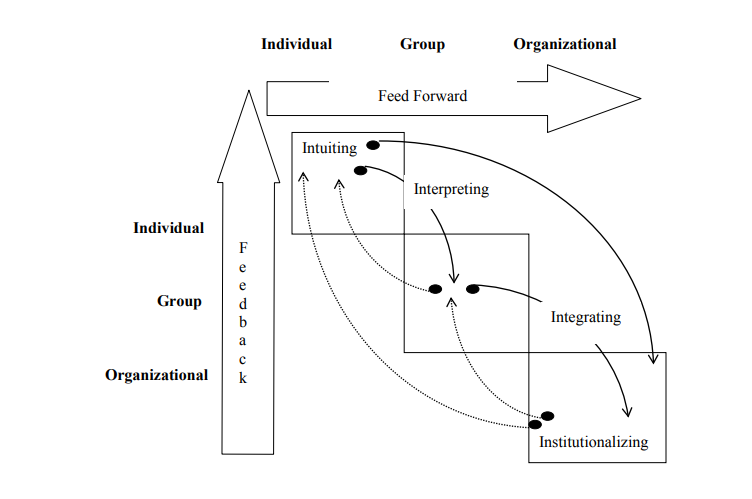
Figure 10. Feed-forward/Feedback organizational learning process. (Crossan, et al, 1999)
Source: M. Crossan, H. Lane, and R. White, An organizational learning framework: from intuition to institution, 1999.
The second component of the transcendent leadership construct, as envisioned by
Crossan, et al. (2002) is renewal. Renewal refers to the ability of the leader - and the organization being led - to adjust to the vagaries of internal and external business dynamics, which "cannot be completely controlled and therefore the need to manage strategy on the edge of chaos" (p. 17). Accommodating a "blend of intended and emergent approaches to strategy" (p. 21), improvisation and responsiveness to rapidly changing dynamics are therefore essential attributes of the "renewing" transcendent leader. Crossan, et al. assert that in chaotic (i.e., open system) environments, the renewing component of transcendent leadership may be highly appropriate and effective, whereas, in less dynamic circumstances, transactional and transformational leadership may be better suited.
In environments that have shifted: (a) from less dynamic to more dynamic, transactional leadership will lead to poor performance; (b) from moderately dynamic to chaotic, transformational leadership will lead to poor performance. A strategic "renewal" orientation [transcendent leadership] will lead to better performance in turbulent times. (p. 22)
Much like renewal, a third component of the transcendent leadership construct, termed resiliency, involves the ability to quickly and seamlessly shift organizational structure, processes, and even leadership roles in order to address environmental flux.
Resiliency, as conceptualized by Crossan et al., proposes a fluid or elastic organizational
culture and architecture where, as the business dynamics dictate, leaders may become followers and followers temporarily assume the role of leaders. In turn, the organizational architecture shifts to meet the demands of the external environment causing not only a disturbance in the system, but more favorably, "ensures the organization is sufficiently destabilized to be actively creative is done through creating compelling goals, ensuring the rich flow of information, and promoting diversity of opinion" (p. 23). Resiliency, through a self-organization orientation, allows for organizations and individuals to shift and then recombine structures, roles, and processes pursuant to the dynamics of the situation and the collective organizational goals held by leaders and followers.
The capacity of a leader to self-examine his or her own foibles skills and interpersonal
relations is the hallmark of the fourth component of a transcendent leadership, as proposed by Crossan et al. Reflection speaks to the leader's inward journey of discovery, or self-system identification. Crossan et al. appear less incontrovertible in their discussion concerning "reflection". Although they skillfully suggest that "Transcendent leaders focus change, not only on their organization and its members, but also on themselves as an integral part of the system" (p. 18), the authors stipulate that further research on the inner dimensions of transcendent leaders would be valuable. Reflection, as intimated by Crossan et al., appears to suggest a journey of self discovery for the purpose of honoring the proccesses of change, instability, integrity, respect, and ethical conduct inherent not only within the organizational context, but more so, within the individual paradigm.
In summary, Crossan, Nanjad, and Vera (2002), drawing upon the bases of extant
strategic leadership theory, have suggested that the exigencies of contemporary organizations may warren a new form of leadership construct capable of accommodating a vastly more fluid and chaotic business environment. That is, as organizations face fundamental upheaval in responding to emergent disturbances in both internal and external environments, organizational structures and strategies are being reshaped. "If new forms of strategy and organizations are required, leadership may also require a new form to be defined" (p. 5). Crossan, et al. offer an a priori assertion that a new form of strategic leadership, termed transcendent leadership, is apposite in responding to the emergent requirements of organizations. They argue that the extant construct of transactional leadership is best aligned with centralized, heirarchical structures and systems (p. 14) and is therefore ill equipped to reflect the need for strategic flexibility and improvisation. In turn, Crossan et al. suggest that transformational leadership - though "more inclined to implement an open culture, an organic structure, and procedures, systems, and strategies that support new learning" (p. 14) - is inadequate in its ability to acclimate a succession of rapid changes. Finally, the authors assert that charismatic leadership, though found effective "in environments of uncertainty and conditions of revolutionary change" (p. 15) is not a style, which can be sustained over timer (Conner, 1998). Given the apparent inadequacies of the transactional, transformational, or charismatic leadership constructs to fully accommodate the new realities of business environments, strategy, or organizational structure, Crossan, et al. (2002) assert that transcendent leadership mitigates these considerations, thus enriching the normative transactional - transformational leadership paradigm. The authors ascribe to the phenomenon the characteristics of receptivity, renewal, resiliency, and reflectiveness and propose that each is integral in defining the construct. (p. 8):
Transcendent leadership requires all four capabilities: fostering an organizational learning
context receptive to new knowledge; developing an open-system orientation that supports the renewing of strategy; creating a self-organizing orientation that allows for a ersilient organization; and adopting a reflective orientation to leadership. (p. 27)
Crossan, et al. offer a trenchant approach toward articulating the reasonableness of a
transcendent leadership construct. Utilizing the contextual factors of an organization, strategy, and environment (Argyris, 1973; Burns & Stalker, 1961; Lewin, et al., 1999a, 1999b), the authors establish a clear rationale for their structural parameters and contextual variables. This approach is consistent with the exhortations of Pettigrew (1987) who asserts that contextual factors be coherent to the research being undertaken and not broadly eclectic.
Crossan, et al. (2002) - along with the propositions set forth by Aldon (1998), Cardona
(2000), and Larkin (1994) - attempt to establish the reasonableness of a new leadership construct by identifying credible distinctions between the extant transformational leadership construct and a proffered transcendent construct so as to warrant the latter the distinction of expanding the poles, or extremes, of leadership theory (Gardner, 1995). Table 11 provides a comparative summary of the assertions made by Aldon (1998), Cardona (2000), Crossan et al. (2002), and Larkin (1994).
Table 11
Comparison of the propositions asserting the reasonableness of a transcending leadership construct.


Conclusion
While each of the proffered studies on transcending leadership (i.e., Aldon, 1998;
Cardona, 2000; Crossan et al., 2000; Larkin, 1994) offer a seemingly credibly description of the construct, none have offered dispositive evidence that would confirm the phenomenon. A crucible, which is absent in the literature thus far presented, is a phenomenological study of leaders who are perceived to possess characteristics which extend the transactional-transformational paradigm. Such an inquiry could serve to support the reasonableness of a transcendent leadership construct and identify a basis, or bases, from which the phenomenon emanates. The intent of this study is to therefore compare extant transactional-transformational leadership theory to the results of phenomenological inquiry with fourteen healthcare leaders and then triangulate any characteristic deviations with proffered transcendent leadership theory. No such rigorous analysis of the transcending leadership phenomenon has been identified in the literature and, as such, it is hoped that this study may contribute to the body of knowledge.
Chapter 2 presented a cursory review of the predominant transactional-transforming
paradigm in context to the historical evolution of leadership theory. Suggesting the emergence of a a new paradigm which could further extend leadership theory, four recently proffered propositions on a transcending leadership phenomenon were reviewed. Chapter 3 presents the framework for the research methodology employed in this study.